Delve into the beautiful flowers that onions bloom.
Onion plants produce a flower cluster, or inflorescence, consisting of numerous small flowers.
In our last post, we explored the onion plant’s unique flowering process, where a tall, hollow stalk (scape) emerges from the center, topped with a conical bud enclosed in a protective spathe. Inside the bud, hundreds of tiny flowerets await their turn to bloom.
Slowly the onion’s protective spathe gives way as buds mature, bursting open to reveal the emerging inflorescence. Over 5-6 days, the buds unfurl, standing tall with the empty spathe providing base support (picture 4).
After a few days, the flowers begin to bloom, adding a vibrant touch to the plant.
The onion’s flower cluster, or umbel, is supported by a sturdy stalk called the peduncle or scape. This umbrella-like structure consists of tiny stalks (pedicels) holding hundreds of small flowers (florets), often over 200! The term ‘umbel’ originates from the Latin word ‘umbra’, meaning shade or shadow, reflecting its umbrella-like shape.
Parts of a floret of the Inflorescence:
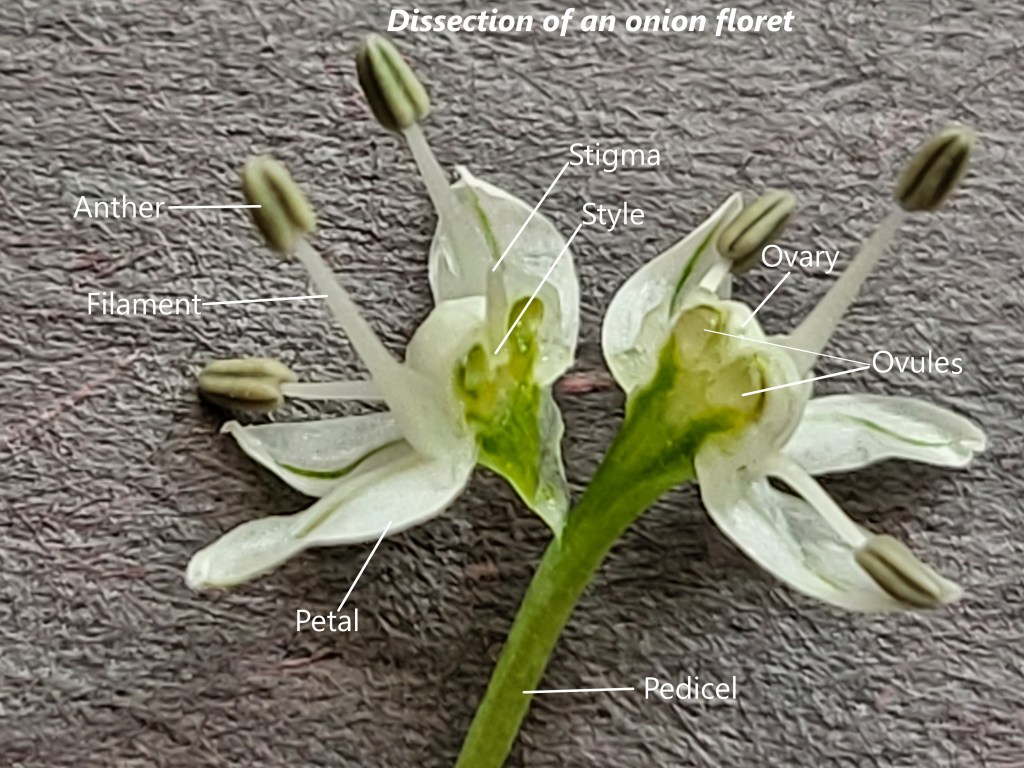
Each delicate flower on the inflorescence featured, 6 white petals with green stripes, 6 stamens (anther and filament), and a central pistil (stigma, style, and ovary), all supported by slender pedicels.
A Curious Dissection
A friend asked me to dissect an onion floret, and I took on the task.
What Secrets Lie Within?
When I dissected an onion floret, I was amazed to find a three-celled ovary, each cell containing two ovules. This intricate design reveals the potential for seed production in each delicate flower.
Onion Floret’s Ovary. We didn’t notice the onion floret’s ovary had three cells until we dissected it. This tiny detail reveals the intricate design of the flower.
A 4-part collage displays the inflorescence’s progression:
A. Initial bloom
B. Buds awaiting bloom
C. Full bloom
D. Gradual drying
Onion seeds are usually ready to harvest after the inflorescence dries out, which takes about two to three months.
However, we couldn’t wait that long and collected 2-3 inflorescences after a month. Despite the seeds being slightly damp and brown, we were thrilled to see them.
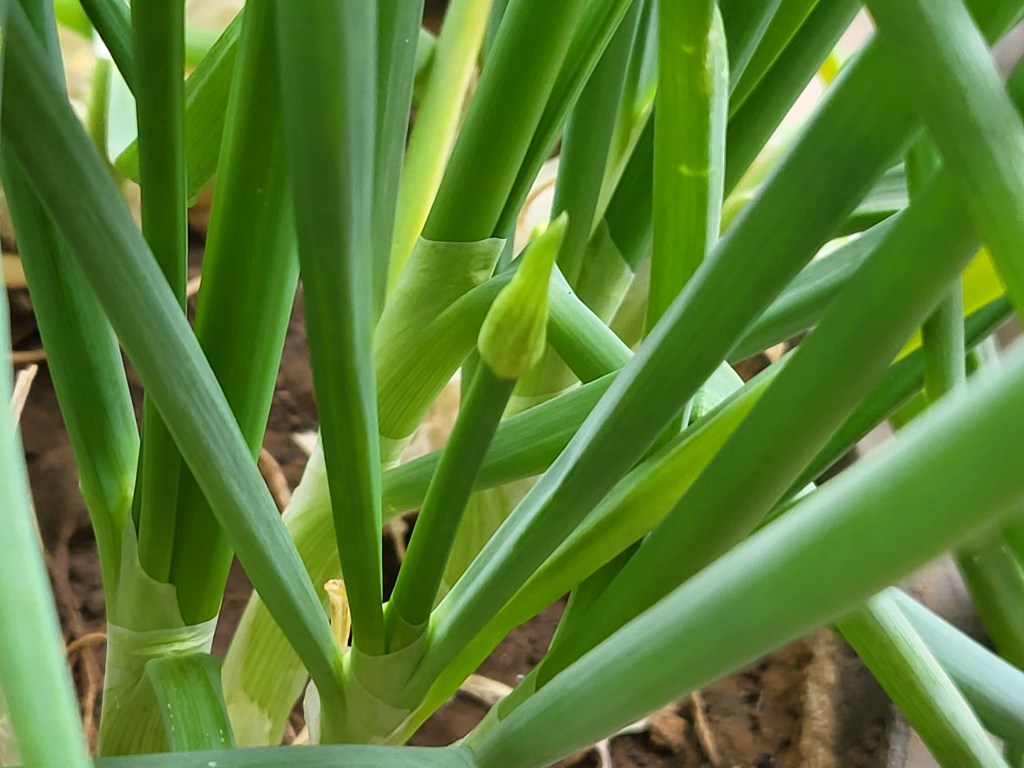
As I examined my onion plants, I was thrilled to notice the emergence of the first flower bud. This unexpected development sparked excitement, and I was eager to learn more.
The cone-shaped flower bud features a protective covering called a spathe, which safeguards the delicate florets inside. The spathe itself is white with numerous parallel green veins that converge at the tip.
The scape or peduncle is the stem that supports the onion flower. It grows from the terminal bud, characterized by its long, hollow, leafless structure with parallel veins, tapering towards the end, and lined with epidermal cells internally.
The Two Phases of Onion Growth
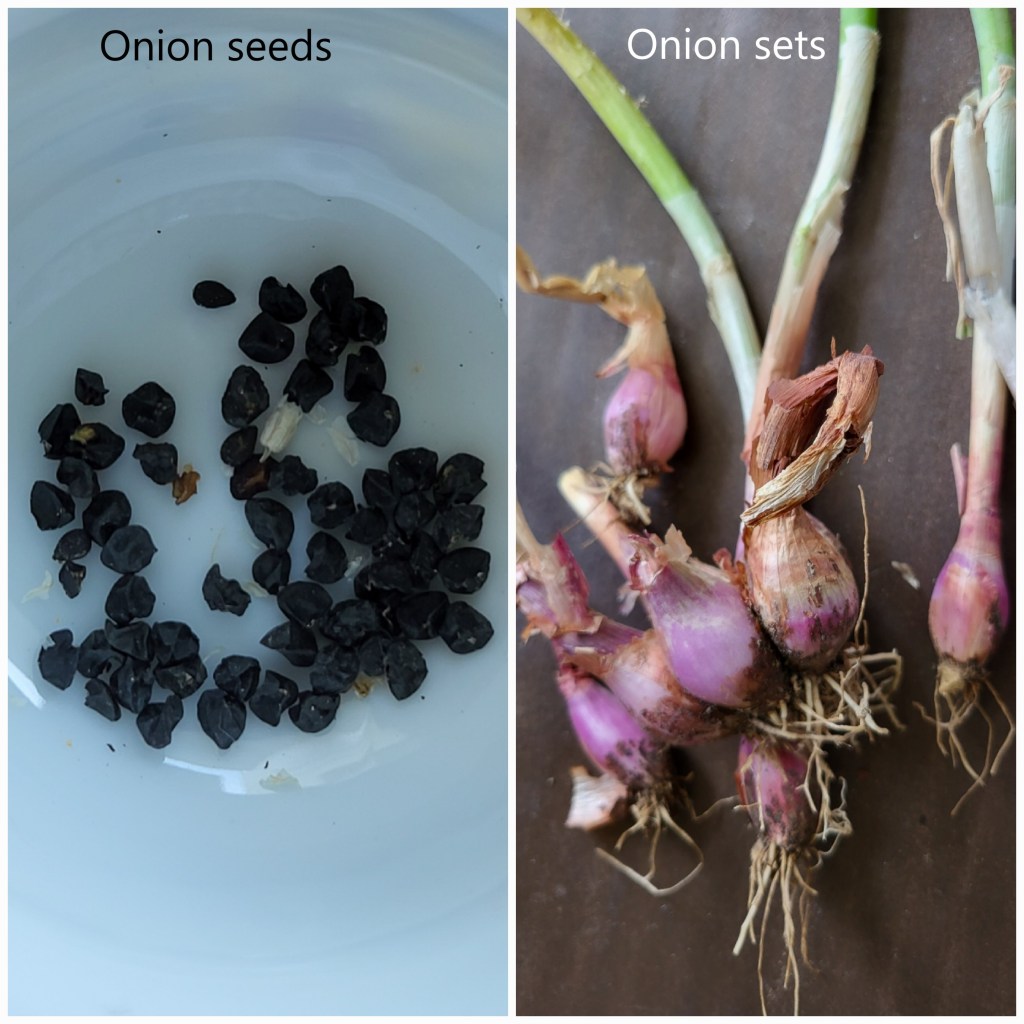
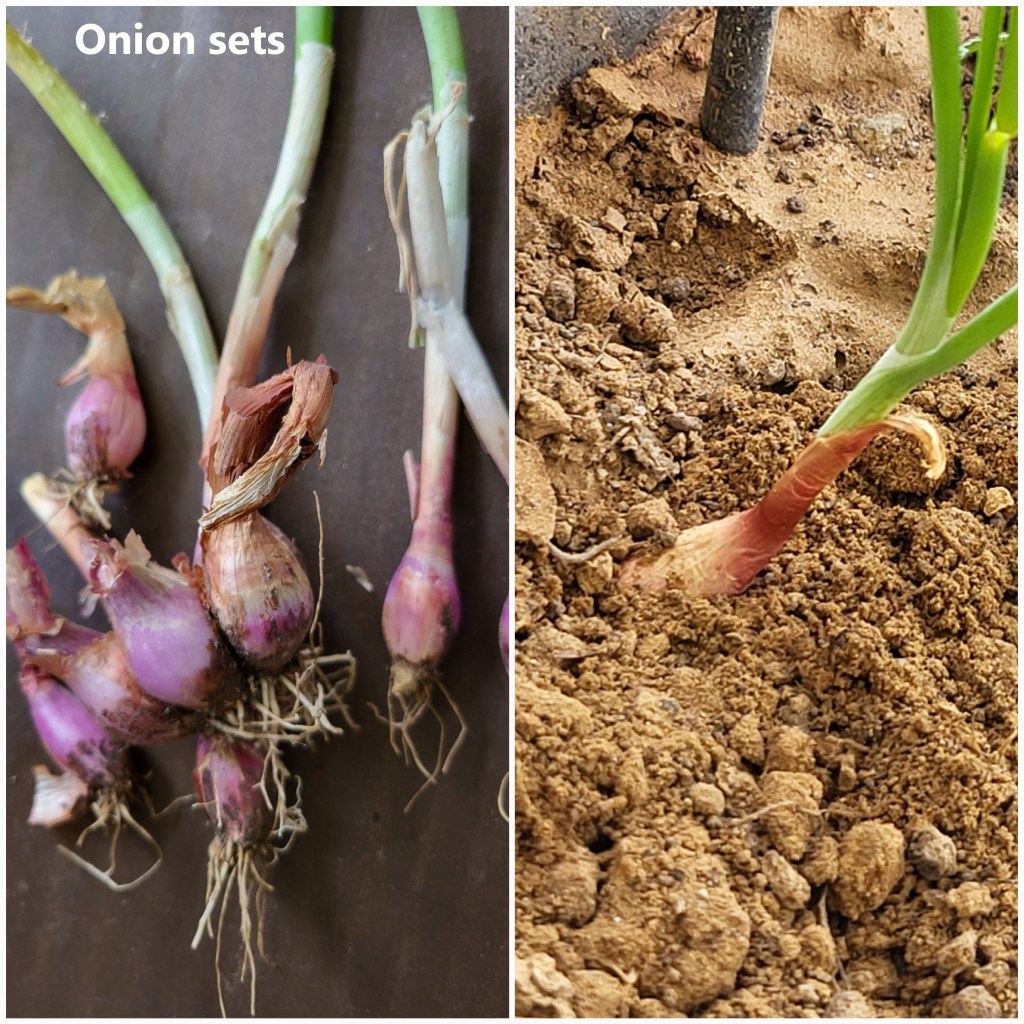
Onion plants typically produce flowers in their second growth phase, following the initial phase of development from seedlings to small bulbs, known as sets.
Onion Bolting
When an onion plant sends up a flower stalk, a process known as “bolting,” it redirects its energy toward seed production, sacrificing the growth of the underground bulb(onion). As the plant focuses on nourishing the flower, the onion remains small. While farmers often remove these flower buds to prioritize bulb growth, I chose to let them bloom, embracing the plant’s natural cycle.
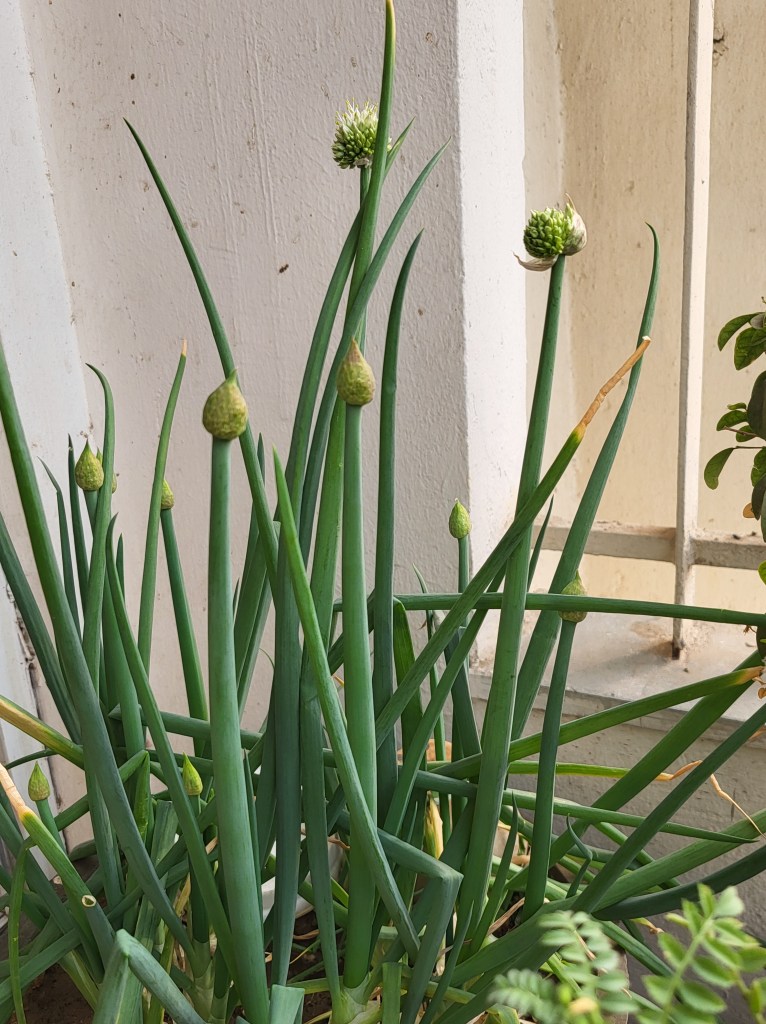
As days passed, our pot became a hub of activity, with many more scapes emerging alongside the leaves. At first glance, it was easy to confuse the two, but upon closer inspection, we noticed that the scapes were slightly thicker and with the distinctive flower buds perched on top.
We waited for almost two weeks for the buds to unfurl. The buds grew bigger and rounder, their skin becoming almost transparent, hence the floret buds are visible from outside.
Interestingly, scapes are edible when they’re still tender and have a mild onion flavor.
Stay tuned for the next update, where we’ll share more about the onion’s inflorescence!
Happy reading!
Coming up next ……. Onion Blooms: The Inflorescence
Onion bulbing occurs when the plant’s energy shifts from leaf growth to bulb formation, storing excess food in the underground bulb, which we harvest as onions. Each leaf on the onion plant corresponds to a specific layer in the bulb, with the plant’s energy storing food in concentric rings as the leaves grow.
This process is triggered by factors like day length and temperature, resulting in the characteristic layered structure of the onion.
Both sunlight and temperature play significant roles in bulbing. When leaves receive sufficient sunlight, they produce food through photosynthesis, which is then transported to various parts of the plant. Excess food is stored at the base of the tubular leaves, contributing to bulb formation. Each green leaf produces food and stores excess in its corresponding sheath.
Onion Planting Depth
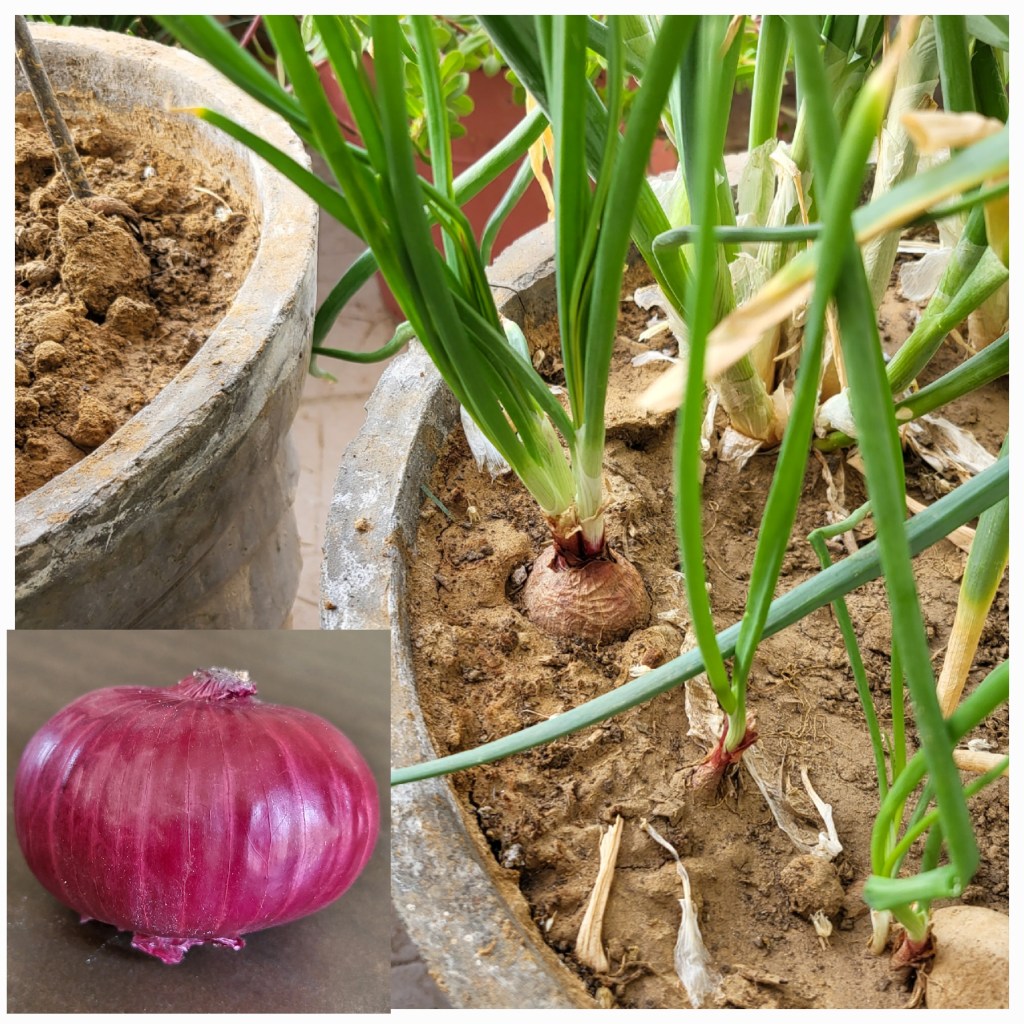
When planting onions from sprouts or sets, it’s essential to avoid planting them too deeply because as the onion bulb grows in size, the deeper it’s planted, the more resistance it will face from the surrounding earth. This increased pressure can result in smaller bulbs. Ideally, about ¼ of the mature onion should remain above the soil surface.
Planting onions no more than ½ to 1 inch deep allows for proper growth and development, which is why the soil often cracks as the bulbing process begins.
Day Length and Bulb Formation
Day length plays a crucial role in onion cultivation. Different varieties require specific amounts of daylight to trigger bulb formation. Understanding these differences is vital for commercial farmers, while home gardeners can benefit from grasping the basics.
The Onion Bulb: A Modified Stem
An onion is a bulb. Botanically speaking, an onion is a modified underground stem with characteristic parts and functions. It is not a stem as we understand. The stem we know, is always above the soil. But in case of onion, the stem remains underground along with its roots.
Onion bulb is covered by a few layers of papery skin/peel called tunic and so it is also known as tunicated bulb. These papery skin protects the bulb from drying as well as keeps them safe from insects and germs.
The stored food in the bulb is in the form of carbohydrates synthesized from sugars produced during photosynthesis.Onions belong to the Allium family, with the scientific name Allium cepa.
Onion Plant Roots
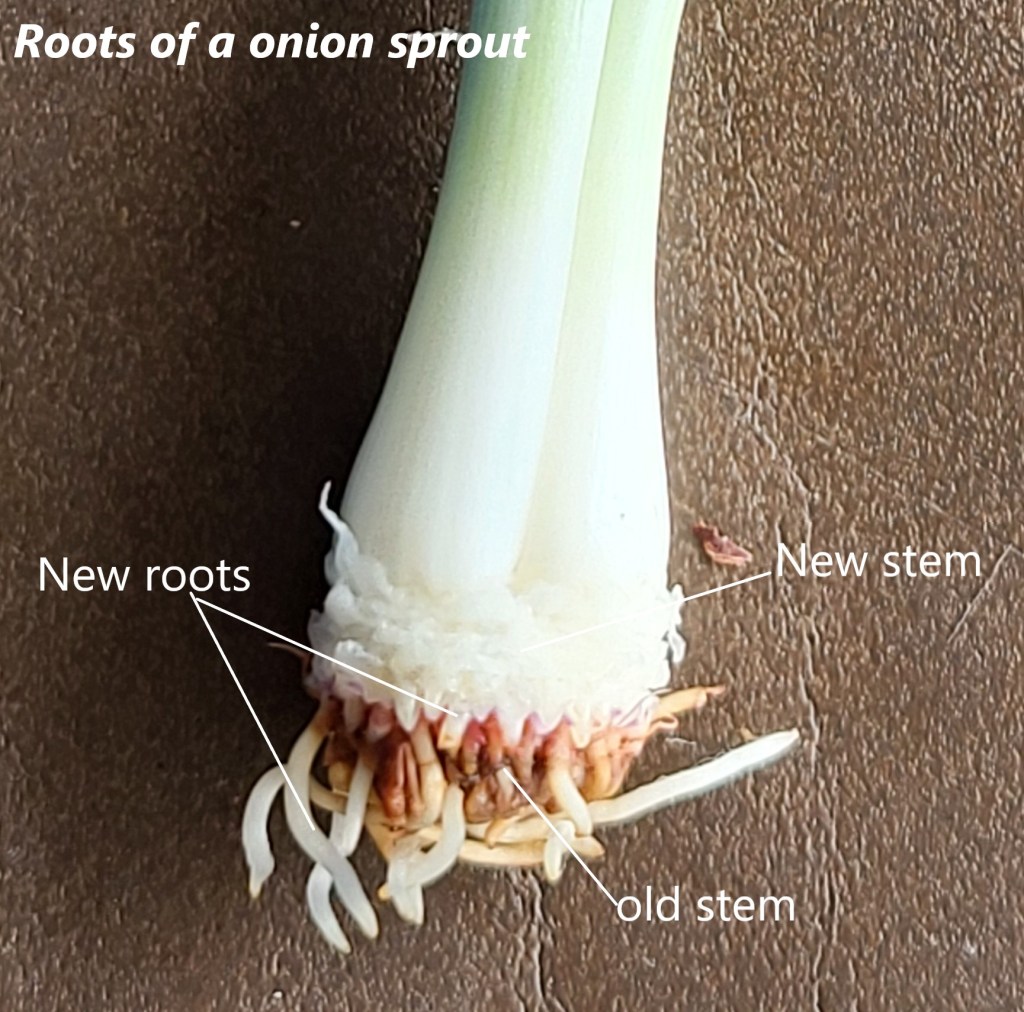
The roots develop from the base of the new stem, distinguishing them from the older stem. Initially delicate and white, the roots increase in number over time, spreading horizontally to anchor the plant and absorb water and minerals.
These roots tend to remain shallow, spreading horizontally to anchor the plant firmly in the soil, rather than growing deep. This positioning allows them to effectively absorb water and minerals from the top layer of soil.
When onion sets are planted, they often quickly establish themselves, producing new roots that spread horizontally. This helps the sets to anchor firmly in the soil and begin absorbing necessary nutrients and water for growth.
The green leaves of an onion plant are long, thin, and tubular, emerging from the base of the plant to form a sheath around the developing bulb. These leaves are typically a vibrant green color and play a crucial role in photosynthesis, supporting the growth and development of the onion bulb.
Unfolding the Green Leaves of Onion Plants
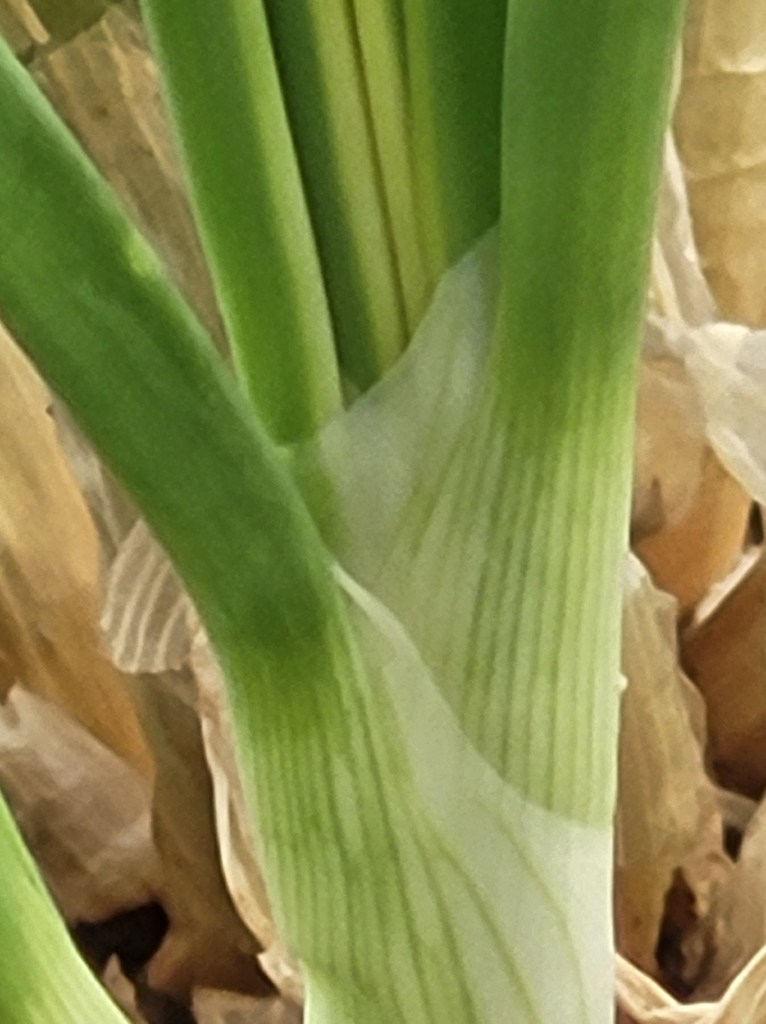
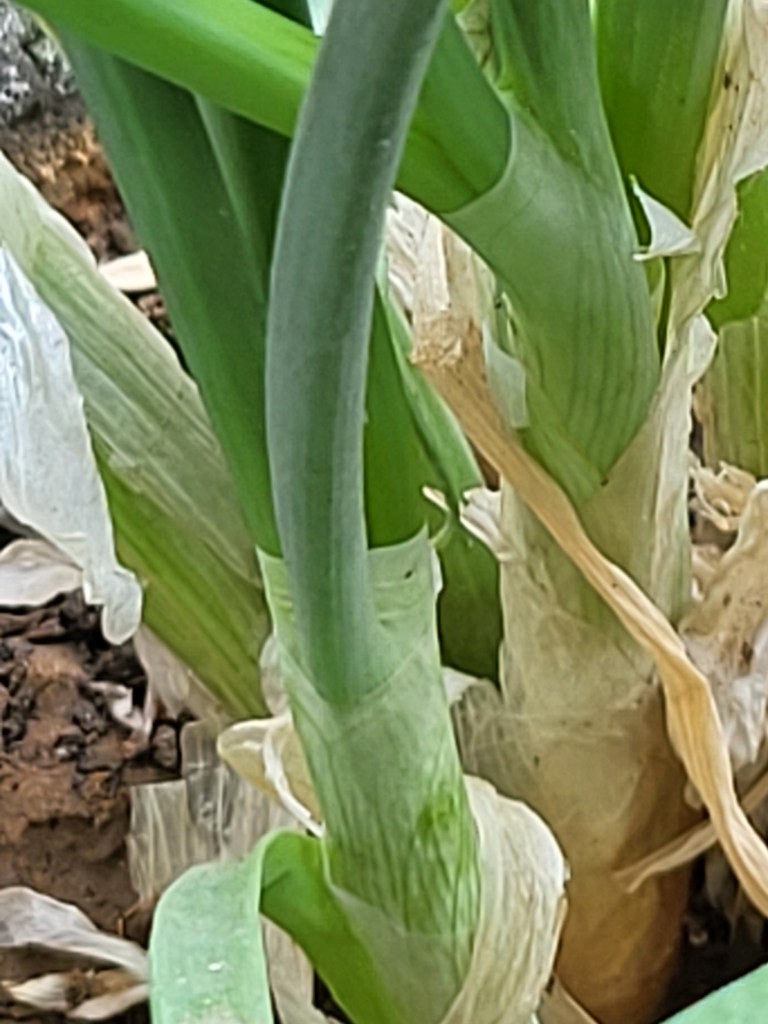
Let’s examine the pseudostem of an onion plant. Notice how green leaves emerge from the tightly wrapped tubular sheaths. Upon closer inspection, it’s evident that the green leaves appear to branch out directly from these sheaths, forming the pseudostem.
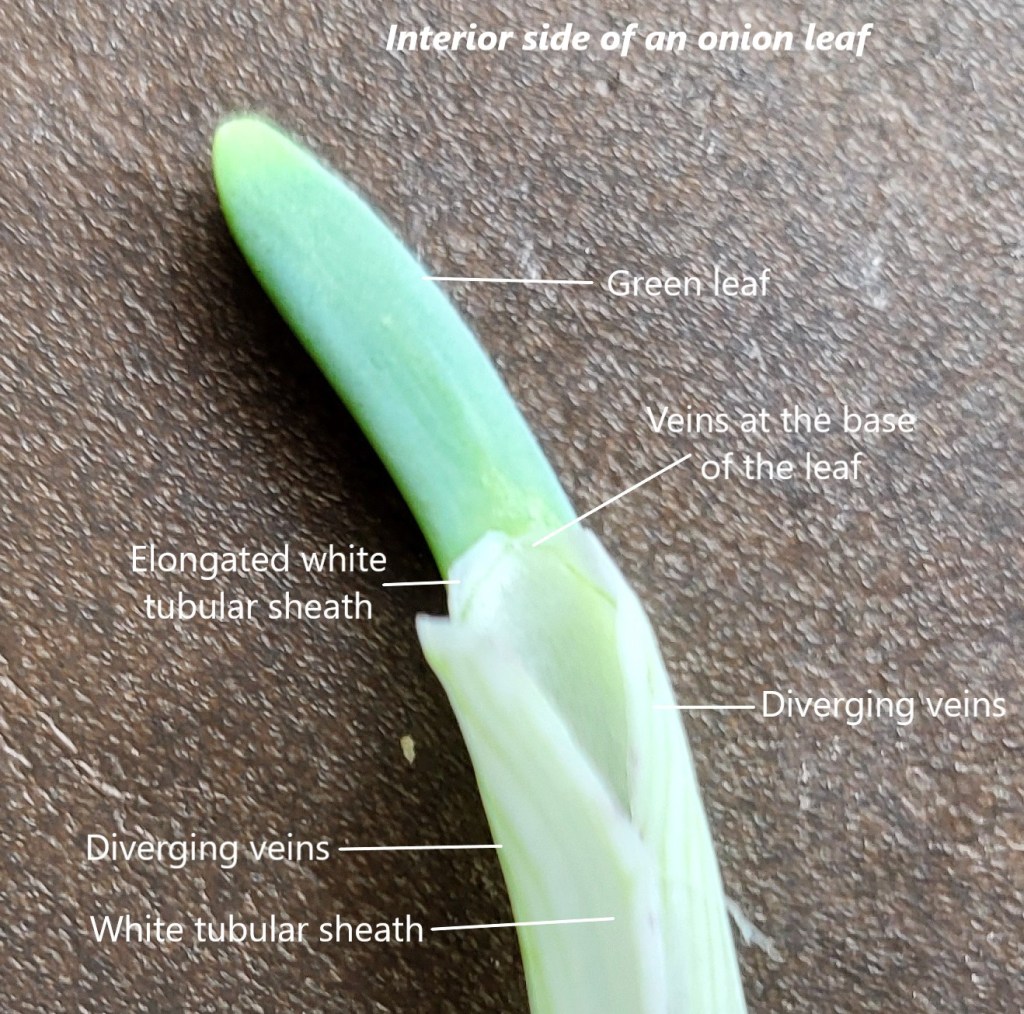
As the onion sprouts grow, the green leaf tissues and pigmentation become active. The veins of the tubular sheath diverge, leading to the base of the green leaf. This is the first green leaf of a sprout
Detailed View of Onion Leaf Interior
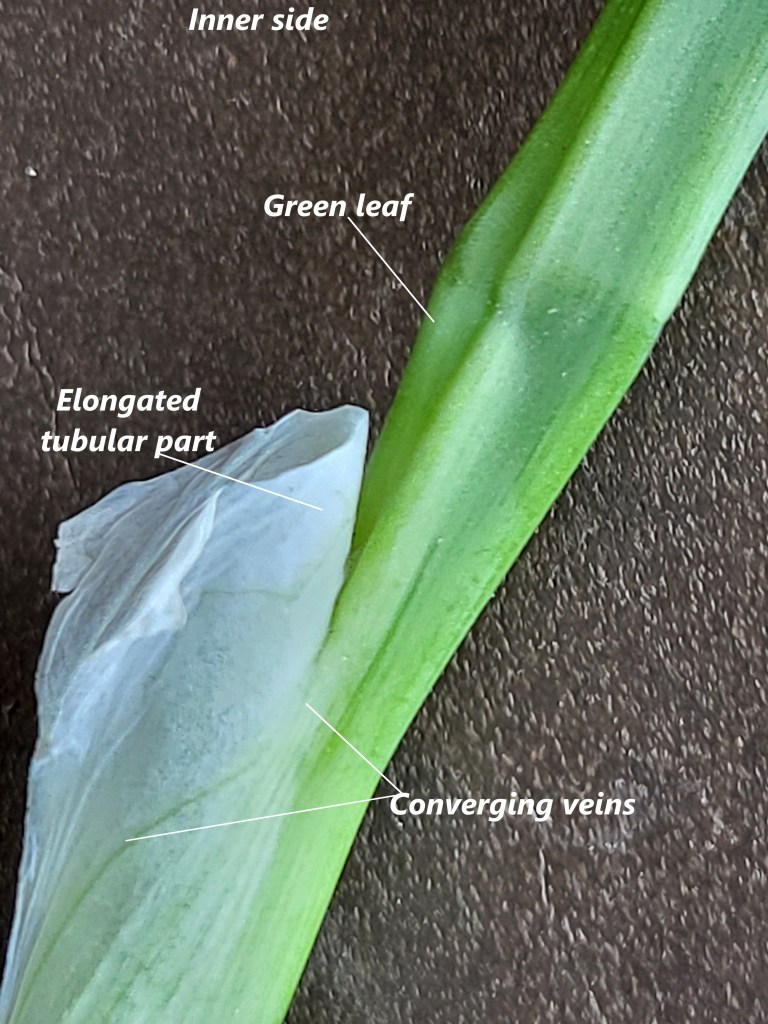
This enlarged picture reveals the interior side of same onion leaf as above, showcasing how veins in the tubular sheath diverge and connect to the green leaf’s base. The veins appear as light green lines within the white tubular sheath. Notably, a small, elongated portion of the white sheath extends above the green veins at the leaf’s base.
Exterior and Interior Views of a Mature Onion Leaf
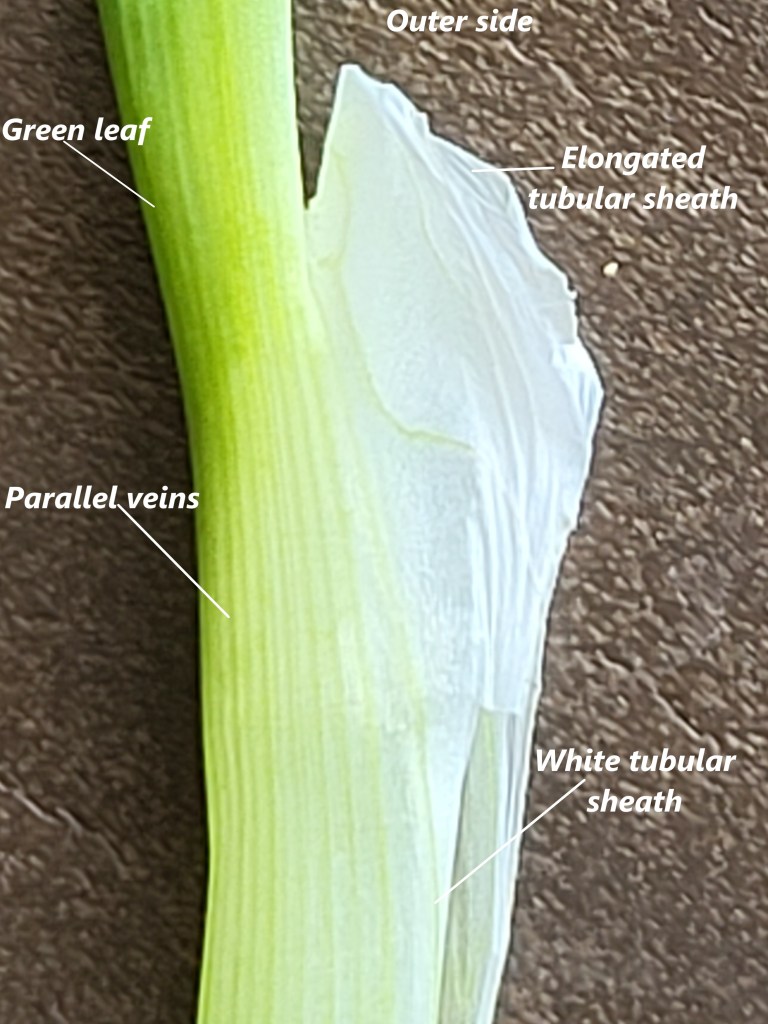
The exterior side of the tubular sheath displays green veins that seamlessly transition into the green leaf.
In contrast, the interior side shows the veins diverging to the right and left, meeting the base of the green leaf.
Interior of a Mature Onion Leaf
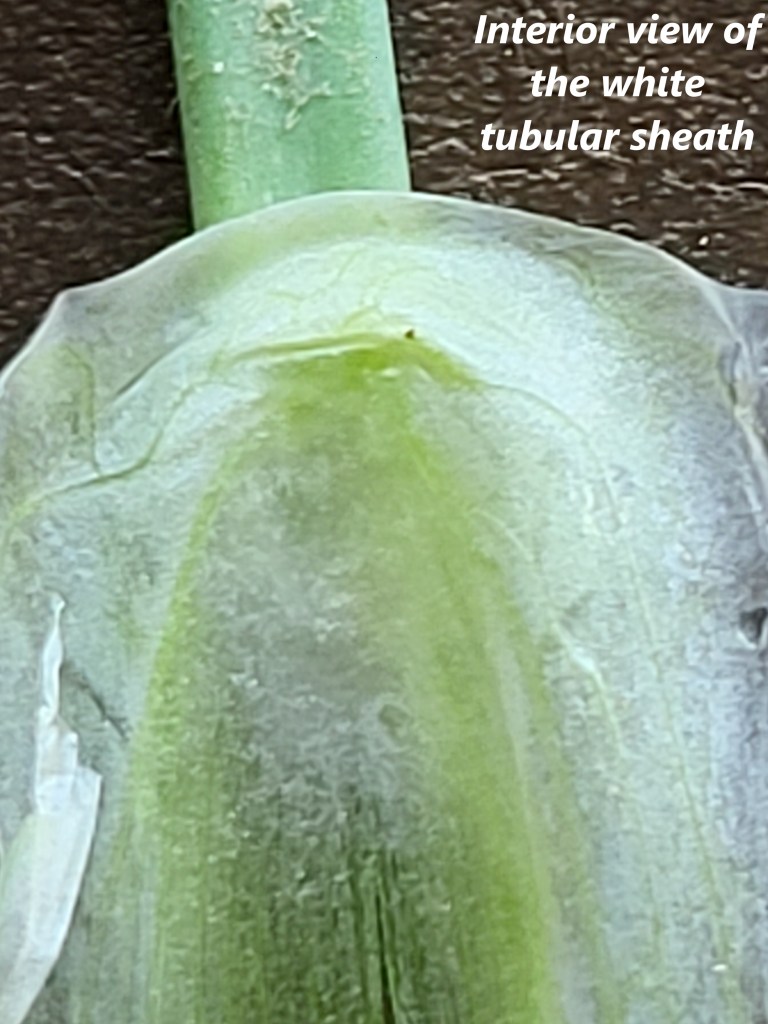
The interior side of a mature onion leaf is displayed flat, revealing parallel and diverging green veins from the tubular sheath. These veins form a silhouette with an elliptical shape at the center, tracing the base of the green leaf. The elongated white tubular sheath provides tight support, cradling incoming green leaves emerging from the center of the plant.
When we gently pressed the white sheath to flatten it, there was a slight tear on the white sheath but revealed the converging veins on the outer side, which became more prominent and seemed to trace the base of the green leaf.
Unwrapping Onion Leaves
It is the picture of the interior side of the same leaf: A 4-part collage reveals its structure.
1. A thin white membrane covers the interior.
2. The arrow indicates the hollow section, housing the leaf base.
3. After removing the membrane, the hollow leaf base is exposed.
4. A cross-section cut through the membrane and leaf reveals its hollow interior.
This examination revealed a distinct feature on the white tubular sheath where the green leaf emerges. Notice how the veins converge into this small area of the green leaf. Our examination showed:
Our observations suggest:
Veins from the tubular sheath connect to the inner part of the green leaf.
The outer side of the leaf remains round, supported by the sheath’s structure.
In contrast, the inner side is flat may be due to two factors: the connection of veins from the sheath and the pressure exerted by the pseudo stem.
The green leaves emerge sequentially from the top, each associated with a tubular sheath that it nourishes with nutrients during its growth.
Characteristics of Onion Leaves
Onion leaves are characterized by their bluish-green color, hollow and curved shape with pointed tips, and a rounded outer surface with a flat inner surface.
They exhibit parallel venation, which supports their structure and facilitates the transport of nutrients and food materials to the onion bulb for storage.
When we open up an onion leaf, we could see the parallel venation more clearly and also see the inside lined with a protective epidermal peel.
Each plant bears about 8-10 leaves measuring around 46-50 cm in length. Understanding onion leaf anatomy provides valuable insights into the plant’s development and function.
The onion’s white tubular sheaths emerge from its stem, playing dual roles: forming the pseudostem to support green leaves for photosynthesis and storing excess food in the underground bulb for later use.
Now let us focus on Pseudostem Formation
The pseudostem is built layer by layer as new leaves emerge from the center of the plant. Each leaf consists of a green blade and a white tubular sheath. The green blade/leaves alternate with sequential tubular sheaths.
As new leaves emerge, they grow through the center of the existing sheaths, pushing through the tubular structures and forming a concentric layer.
This process repeats, adding layers to the pseudostem, which provides structural support to the plant, allowing it to grow upright and expose its leaves to sunlight.
The green leaves, at the top, are responsible for filling their corresponding tubular sheath with nutrients during its lifetime.
A Closer Look at the Tubular Sheath and Green Leaf
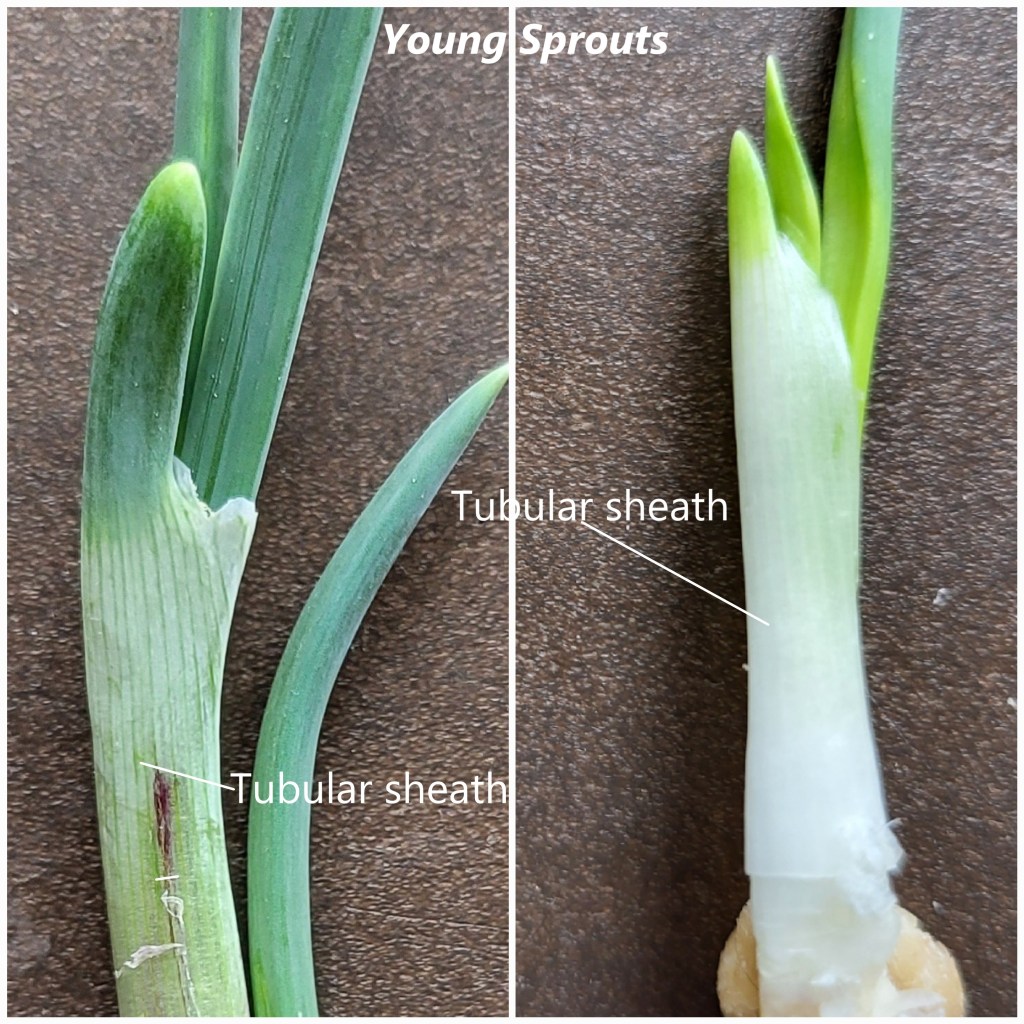
As new green leaves emerge, their tubular sheaths wrap tightly around the inner leaves, offering support and protection. This process is particularly visible in young sprouts, where the overlapping sheaths form a sturdy pseudostem.
In this way, each sheath holds the inner green leaves snugly, with each subsequent sheath growing slightly higher than the last. This layered structure allows the green leaves to emerge progressively higher, exposing them to sufficient light for photosynthesis and thus forming the pseudostem.
Veins of Tubular Sheath and Green Leaf
The veins of the tubular sheath seamlessly extend into the green leaf. When viewed from the outer side, the veins run parallel.
In contrast, the inner side shows a converging pattern, where the veins of the tubular sheath meet the green leaf, forming a flat surface. This arrangement allows for tightly packed green leaves.
The green leaf branches out from this point, while the tubular sheath continues to elongate a little, wrapping tightly around emerging inner leaves.
As each new leaf emerges, its tubular sheath wraps protectively around it, supporting the leaf during growth. This process repeats with each subsequent leaf, which creates elliptical holes or openings in the sheath as it pushes through. The result is the characteristic structure of the pseudostem.
As we previously discussed, the green leaves grow in an alternating pattern from the tubular sheaths, resulting in the distinctive V shape due to the slight extra growths from the sheaths, ultimately forming the wonderful pseudostem.
The tubular sheaths possess flexible properties, allowing them to stretch and accommodate the plant’s growth. However, over time, the sheaths become increasingly thin and fragile, eventually succumbing to wear and tear.
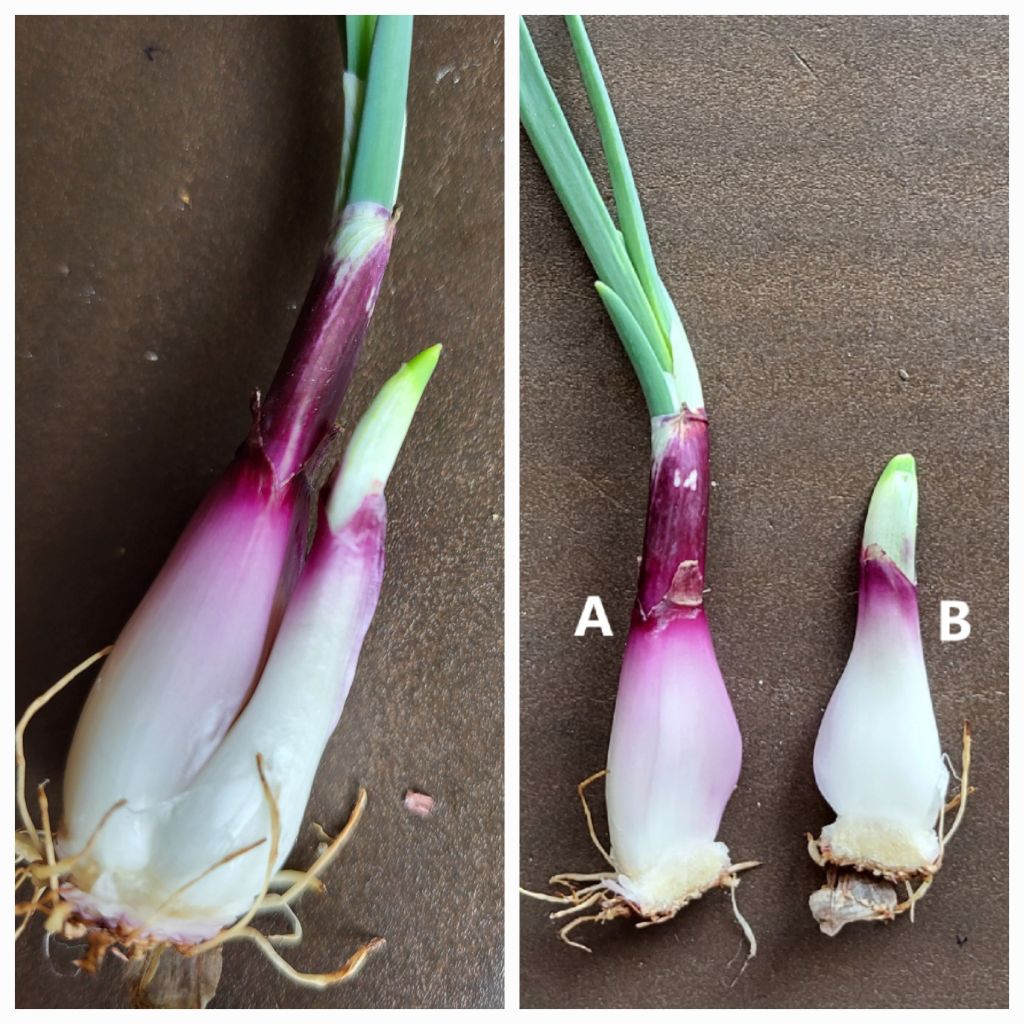
Recall our last post, where we carefully separated the two sprouts and labeled them A and B? We highlighted the incredible potential of sprout B, showing its compact structure and remarkable growth capabilities, which make it a powerhouse in its own right.
Today, we’re excited to share the next chapter in this growth story, as sprout A has made significant strides and grown into a small, flourishing plant.
Upon removing the last fleshy, white-purple layer, we discovered two small sprouts emerging once more.
We separated the two sprouts, labeling them A1 and A2, and presented them individually for clearer visualization.
Let’s take a closer look at Sprout A1.
To begin, we’ll carefully dissect the first tubular sheath.
The first leaf features a short green blade and a long tubular sheath, with a hole allowing the second, third, and fourth leaves to emerge. In contrast, these subsequent leaves have longer green blades but shorter tubular sheaths, roughly half the length of the first leaf’s sheath.
As the leaves grow, the first leaf becomes the outermost layer, while subsequent leaves (second, third, and fourth) develop longer green blades compared to their white tubular sheaths.
These new leaves emerge from the young stem situated just above the older mother stem. Remarkably, this tiny sprout contains all the same components as its parent plant, making it a miniature version of a full-grown onion plant.
Examine the tiny plant on the right-hand side of the picture. Notice the new bud stem and the white tubular sheath, which will eventually develop into the pseudo-stem and the bulb. The pseudo-stem will support the green leaves, exposing them to sunlight to produce food for the plant and ultimately form the onion bulb at the base.
A Closer Look at Sprout A2
Notice the first green leaf: small and nestled within a tight white tubular sheath that encases longer inner leaves. Sprout A2 also showcases a new baby bud stem, giving rise to these leaves. This tiny stem contains axillary and terminal buds, essentially making it a mini plant.
These miniature onion plants are remarkable, equipped with everything needed to grow into thriving onion plants. Let’s appreciate these tiny powerhouses and watch them flourish!
Seed2Seed: Know your Kashmiri Rajma/Kidney bean through leaves and flowers.
The origin of rajma, also known as kidney bean, is Mexico. It was introduced to India by the Portuguese via Europe. Over time, the Kashmiri/Jammu rajma evolved from the regular kidney bean due to geographical and climatic conditions.
Kashmiri rajma, is smaller in size, brighter in colour, and tastier than the regular kidney bean. Although it’s a pulse, it’s used extensively in Indian kitchens, much like dal.
Rajma is a nutrient-rich food. Its scientific name is Phaseolus vulgaris. It’s an excellent source of protein, fiber, iron, and vitamins.
To get a glimpse of the plant’s life cycle, try sowing some rajma seeds and watch them grow. Observe the leaves and flowers as they develop.
Welcome to Seed2Seed!
In this project, we embark on a fascinating journey, sowing seeds and observing their transformation into plants. We’ll witness the seeds germinate, grow, and develop leaves, flowers, and fruits. Ultimately, these fruits will produce the same kind of seeds we started with.
But what exactly is a seed?
A seed is the embryonic stage of a plant’s life cycle. It’s a tiny, self-contained package that holds the potential for new life. A seed consists of three main parts:
1. Embryo: The embryo is the tiny, undeveloped plant inside the seed. It’s not visible to the naked eye, but it contains the genetic material necessary for growth.
2. Endosperm: The endosperm is the nutrient-rich tissue that surrounds the embryo. It provides the necessary nutrients for the seedling to grow.
3. Seed Coat: The seed coat is the protective outer layer of the seed. It shields the embryo and endosperm from damage and provides a safe environment for germination.
By understanding the structure and function of seeds, we can appreciate the incredible process of plant growth and development.
Is Rajma a Seed?
Let’s conduct a simple experiment.
Soak a few rajma beans in water for a couple of hours. This will make them softer and easier to handle.
Remove the rajma beans from the water and wipe them carefully.
3. Use a blade or pin to carefully remove the red skin. This is the seed coat.
4. Slit open the seed and observe the two fleshy, white, leaf-like structures. These are the cotyledons or seed leaves, also known as the endosperm. They contain the nutrients for the new plant.
What’s Inside?
Inside the cotyledons, there’s a tiny structure (not easily visible) that’s the future plant of the seed. This is called the embryo. (see the picture above)
Now that we’ve explored the internal structure of rajma and rajma fulfils all the three criteria of a seed, we can proceed with our experiment!
Seed2Seed
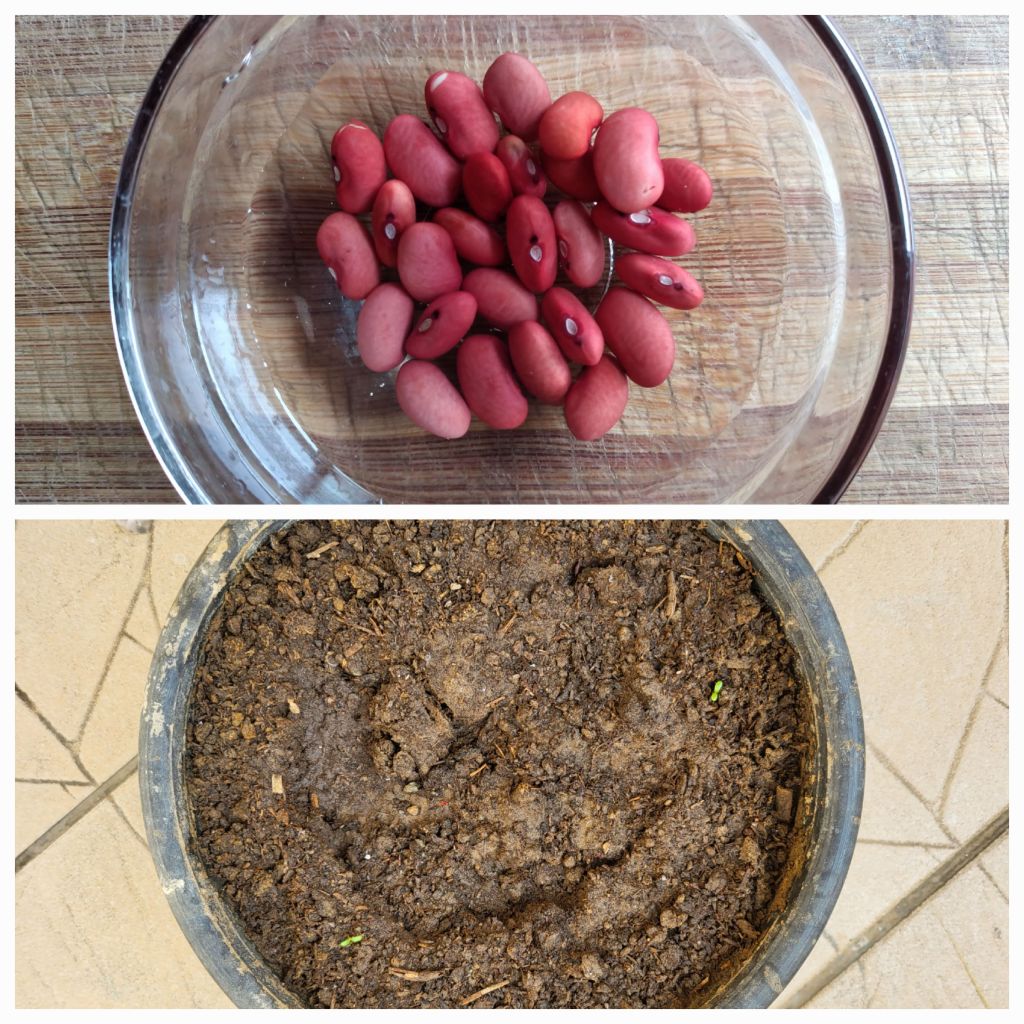
Prepared a pot and soaked few rajma seeds overnight. When the seeds absorb the water, the germination is activated.
Sow the seeds 2 cms below the soil and watered them sparingly.
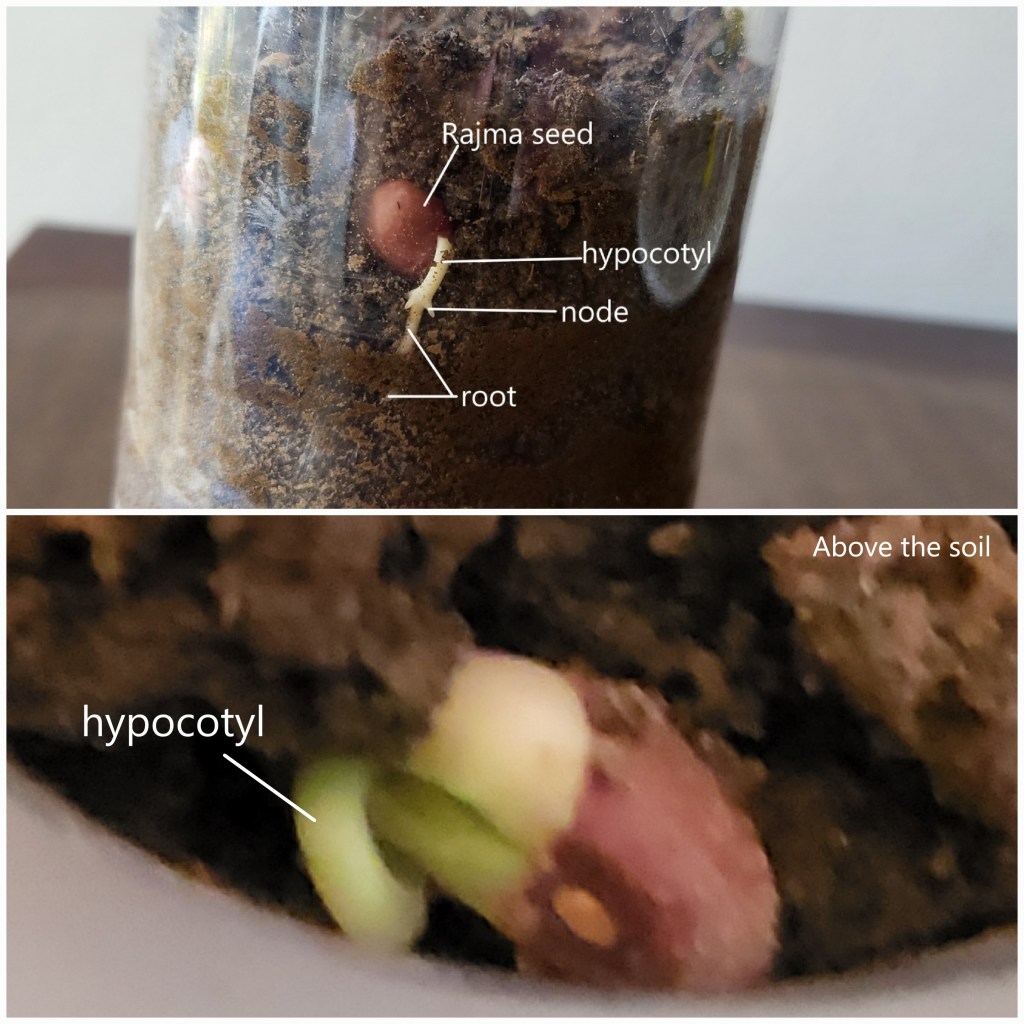
After about 7 days, a white coloured hook emerged from the soil, which is called Hypocotyl.
What is Hypocotyl?
The Germination Process under the soil:
We planted a few rajma seeds in a glass container for you to make it easier.
When a seed is planted in the soil, it may seem like nothing is happening for a few days. But beneath the surface, germination has begun. The first visible sign of growth is the emergence of the radicle, the embryonic root of the plant.
As the radicle grows downward in search of water, a node forms on the root from where a small portion begins to elongate and push upwards towards the light. This elongated portion is called the hypocotyl, marking the beginning of the seedling’s journey towards the surface.
As the hypocotyl grows, it carries the seed’s cotyledons and plumule upwards towards the light. Growing rapidly, the hypocotyl breaks through the soil surface, forming a hook-like shape while the seed remains underground. This distinctive shape earns it the nickname “plumule hook.”
Later, the seed emerges, still encased in its coat, with the cotyledons and plumule intact. As the seedling develops, the hypocotyl straightens and matures into the plant’s stem.
When the seed appears above the soil during germination it iscalledepigeal germination (epi = above, geo = earth).
Day 8: Germination Update
On the 8th day,a significant development occurred. The seed coat had burst open, revealing a glimpse of the plumule inside the cotyledon. The red seed coat was still partially attached, a reminder of the seed’s transformation.
The little rajma bean’s progress is adorable! Watching seeds germinate and grow is a magical experience.
Day 9: A New Transformation
Overnight, a magical change occurred! The cotyledons and plumules turned a vibrant green. As they grew, their names also changed. The plumules now became known as true leaves, while the cotyledons transformed into seed leaves.
Growth and Development
The Emergence of a New Plant
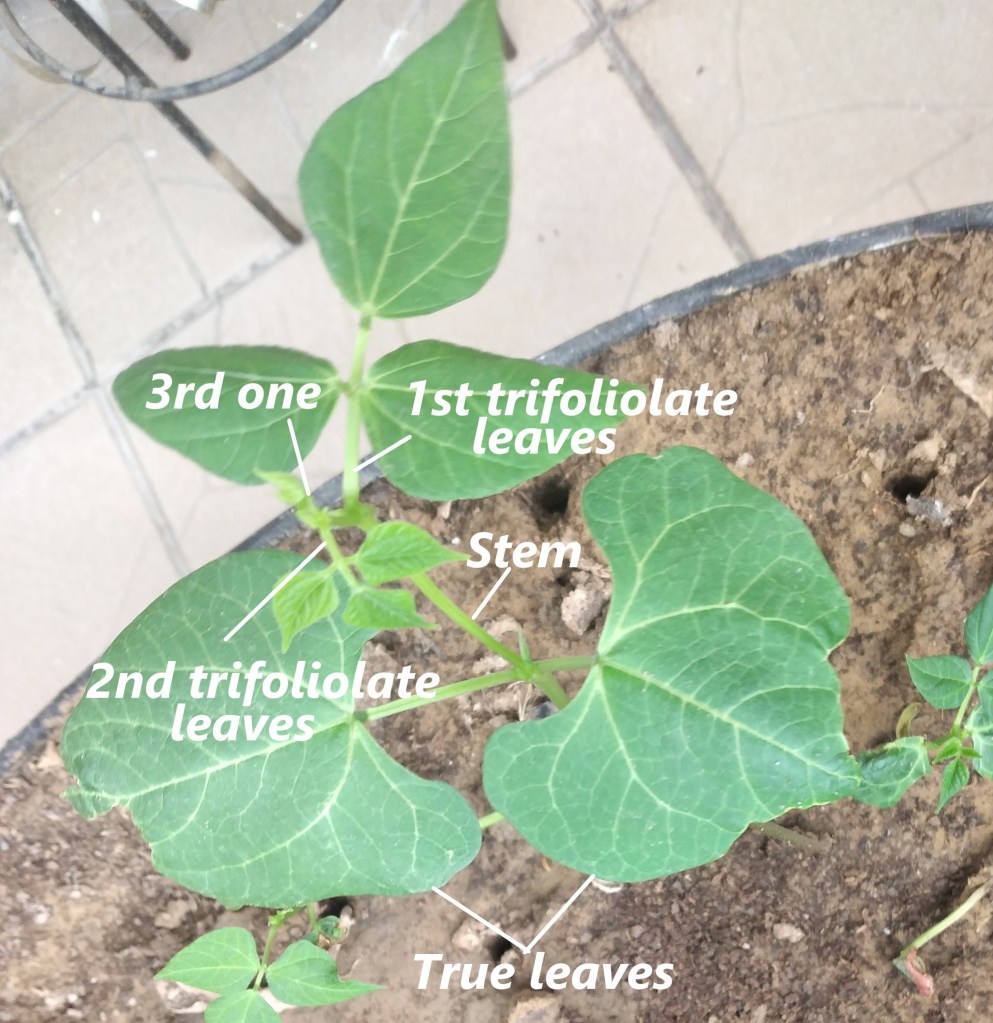
The hypocotyl is the portion between the root and seed leaves (cotyledons), while the epicotyl is the portion between the seed leaves and true leaves (plumule). True leaves are broader and heart-shaped. A stem bud emerged between the two true leaves.
The seed leaves provided stored nutrition to the new plant. As true leaves developed, they began to produce food for the plant. Meanwhile, the seed leaves shrivelled up. The young plant actively produced new stem and leaf buds.
Leaf Development
The first leaf that appeared was a 3-lobed trifoliolate leaf. Trifoliolate leaves have three leaflets attached to a common stalk.
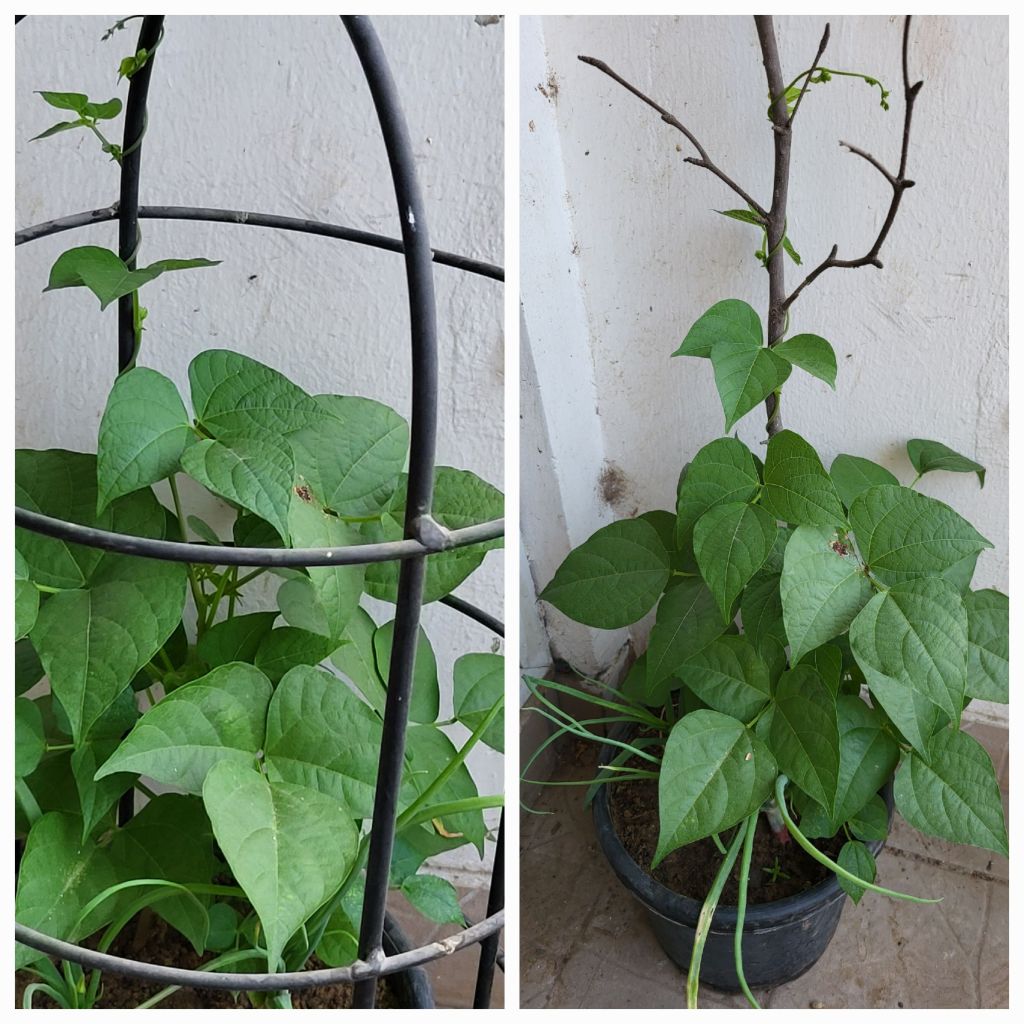
Leaves continued to appear on the stem, growing into a beautiful plant.
Support and Protection
To protect the plant from pigeons, we covered it with an iron frame. As it grew, we removed the frame and supported the plant with a twig.
Flowering and podding
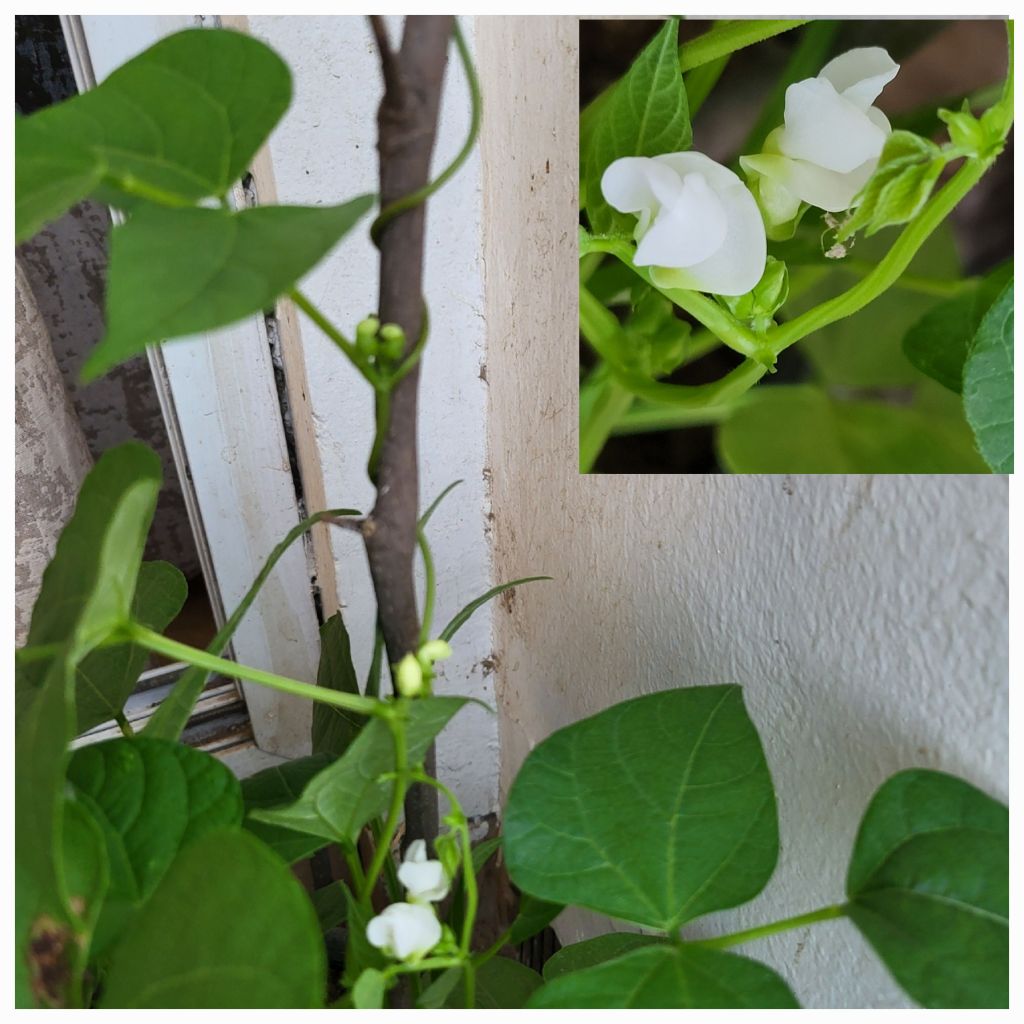
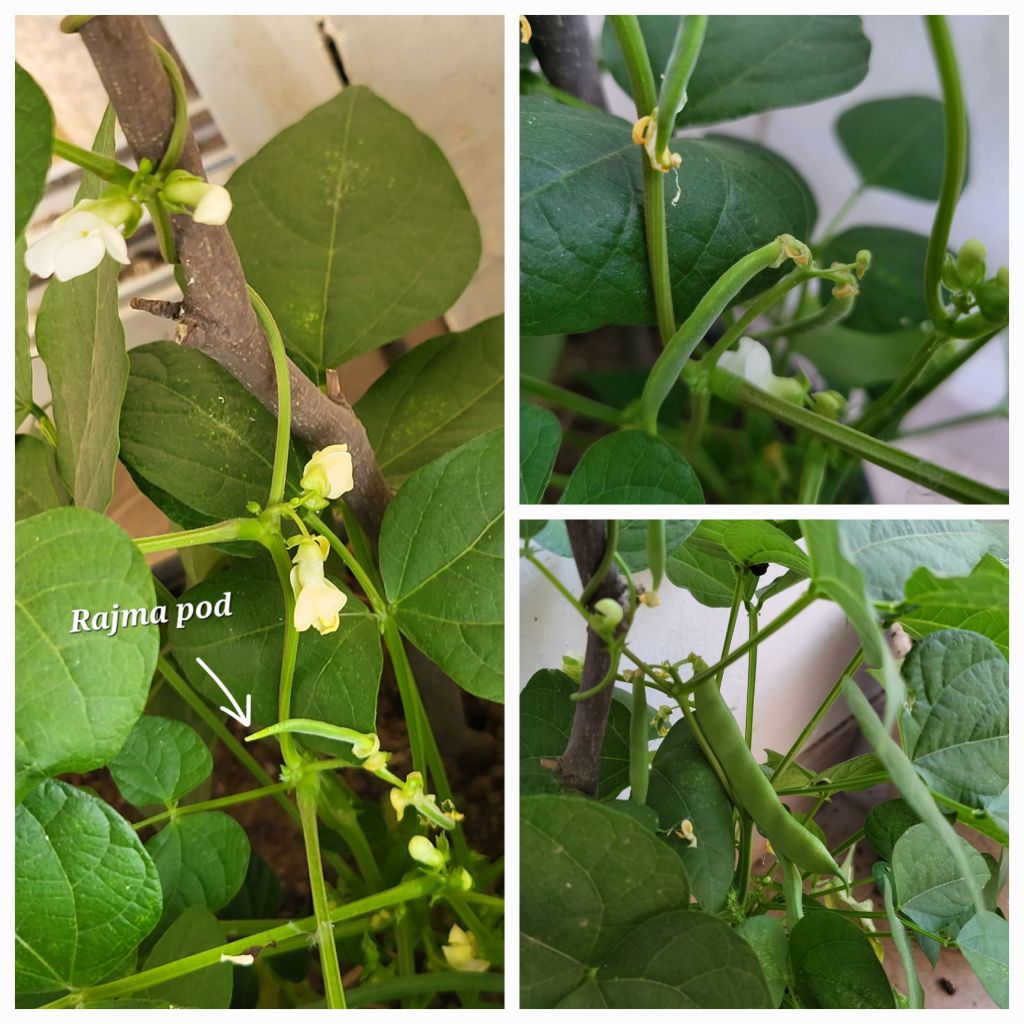
Beautiful white flowers adorned the plant, followed by more flower buds.
The first rajma pod appeared after 3 days, and soon more pods emerged. The base of the plant branched into several branches, promising a bountiful harvest.
Seed Development
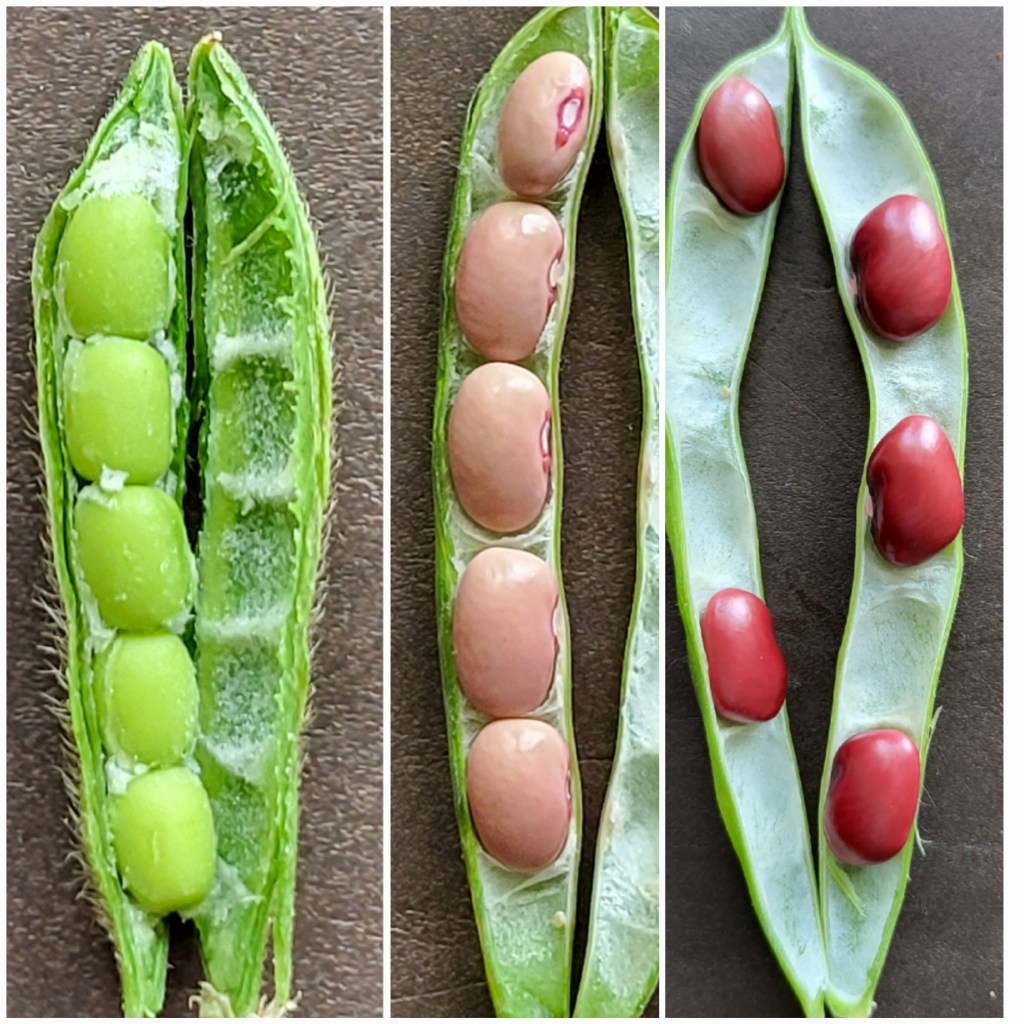
At this early stage, the pod is difficult to open. It is tight squeeze. Upon closer look, we can see that only two seeds have begun to develop, while the others are still waiting to emerge.
As the seeds mature, they fill the pod and undergo a colour transformation:
1. From green to pinkish hues. 2. Eventually turning bright red.
Take a look inside the rajma pods! You’ll find 5-6 seeds attached to the inner curve of the pod, where they receive nutrients and grow.
We carefully removed the pods, extracted the seeds, and revealed the beautiful, red, gem-like seeds.
A Speedy Harvest!
Typically, rajma plants take around 4 months (100-140 days) to mature from seed to harvest. But our little plants grew and reaching harvest readiness in just 95 days!
In one of our last posts, we separated and planted the sprouts, watching them grow into full-fledged onion plants. But have you ever stopped to think about what makes these sprouts so special?
Today, we’re going to take a closer look at these tiny wonders and uncover the secrets behind their remarkable growth. So, what makes sprouts miniature plants, and what can we learn from them?
Studying a sprouted onion with emerging leaves is a great way to learn about how they grow. And we’re lucky to have a perfect specimen!
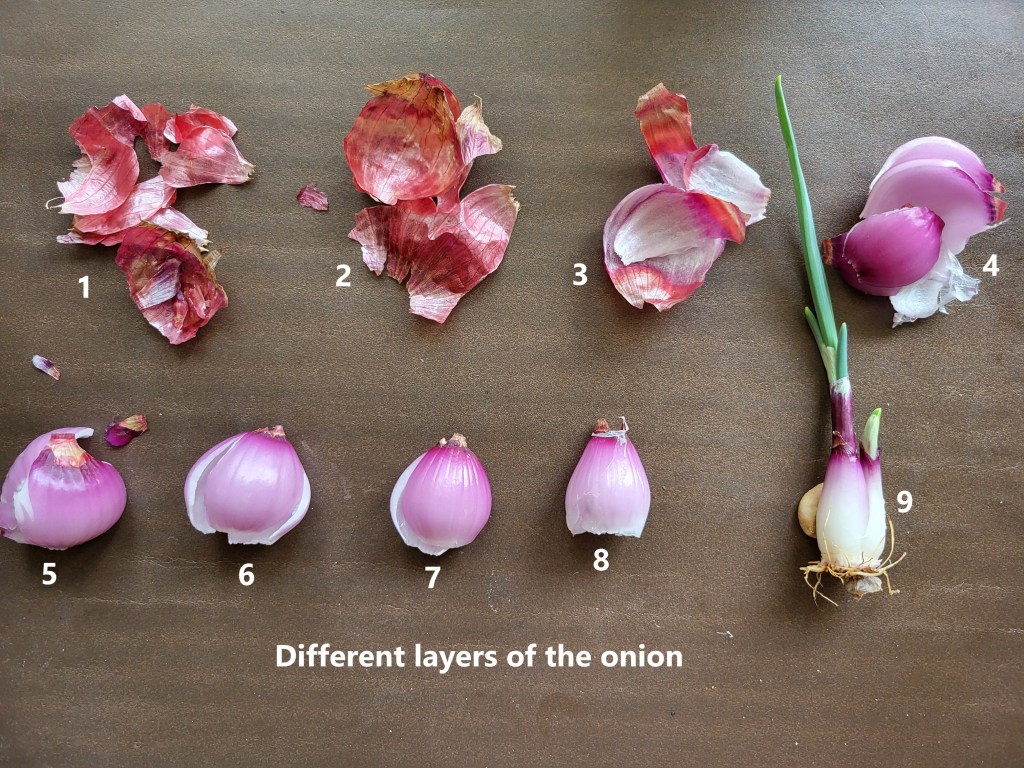
Upon gently peeling away several layers of the dry papery and fleshy leaves, we reached the 8th layer, revealing the two hidden sprouts beneath (9).
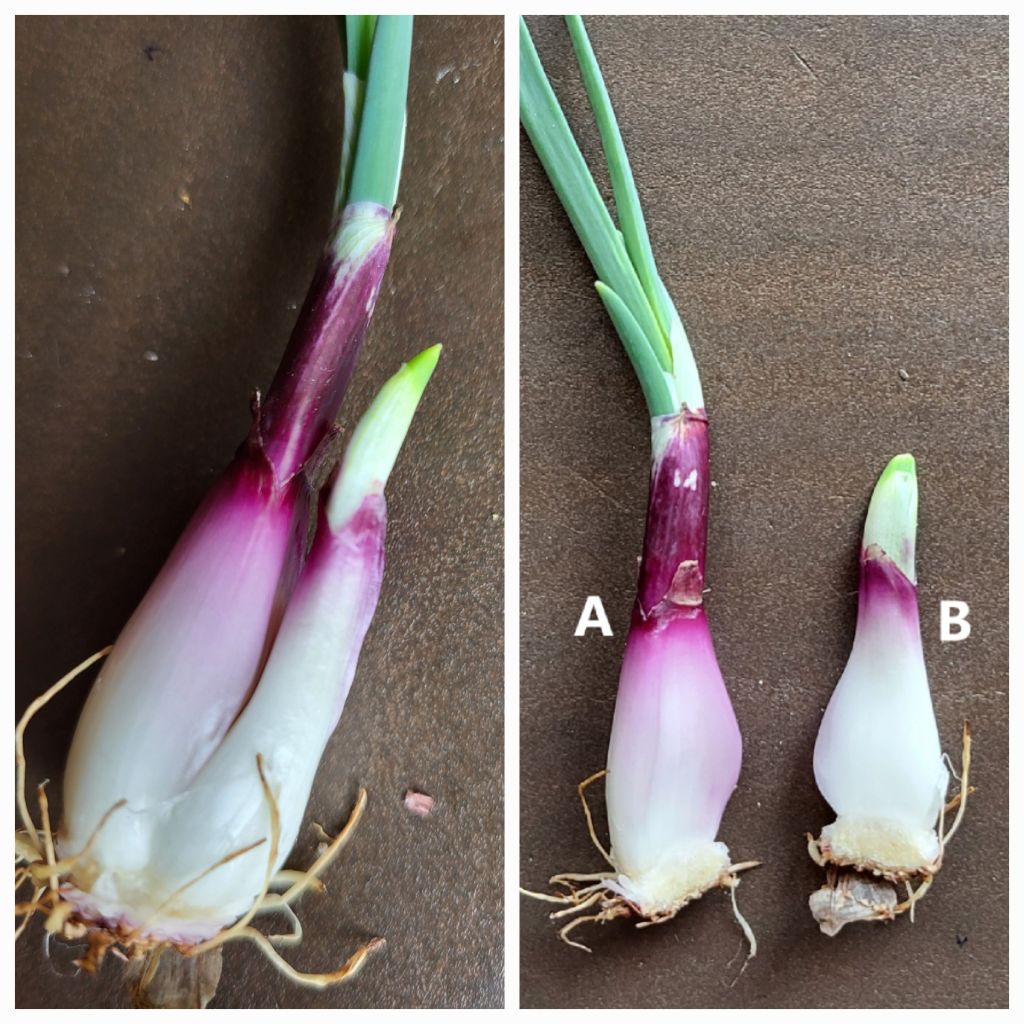
We labeled the two sprouts A and B for closer observation.
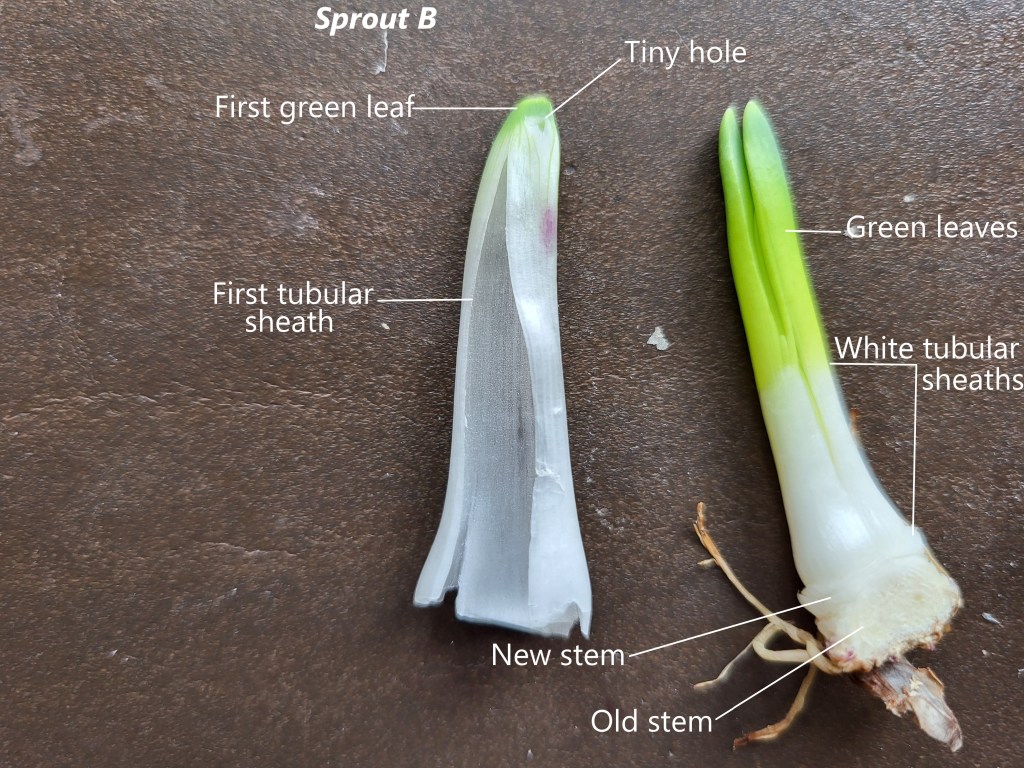
Let’s take a closer look at sprout B, which is smaller and hasn’t yet unfurled its leaves. We’ll start by gently removing the white and purplish fleshy leaf that’s wrapped around it, which is actually a remnant from the mother onion.
As we carefully peel it away, we’re left with a white, tubular sheath that has a green tip along with the stems of both the new and old onion.
We’ll refer to one side of the sprout as the ‘inner side’. This is because this side was originally attached to the other sprout, and we made a cut here to separate the two sprouts.
Take a closer look at sprout B and notice the tiny opening on the inner side. This small opening is the only exit route for the green leaves still inside the tubular sheath.
We carefully made a small slit near the tiny opening, extending it down towards the stem. Gently opening it up revealed the green leaves tucked inside the tubular sheath.
It’s possible that initially, this tiny hole was larger, matching the circumference of the new bud stem. Over time, the onion white tubular sheath may have closed in, leaving behind only a small opening for new leaves to emerge.
If this is the case, the process might repeat for every emerging leaf. The onion leaves grow very rapidly during sprouting. New leaves emerge before the outer tubular sheath can close.
As a result, we’re left with a picture of white, tubular sheaths wrapped around each green leaf, just like in the picture.
Take a look at the tiny plant on the right-hand side of the picture. It has a new bud stem. It has the white tubular sheath which will become the pseudo-stem and expose the green leaves to the sun to produce food for the plant and eventually form the onion at the base. This tiny sprout has all the parts of a big onion plant. So, a tiny sprout is a miniature onion plant.
Here is another Sprout X, that illustrates this process perfectly: the sprouting leaves have emerged, gradually enlarging the tiny hole.
Next, we’ll take a closer look at Sprout A, where the leaves have already emerged from the bud casing. Stay tuned for our next update!
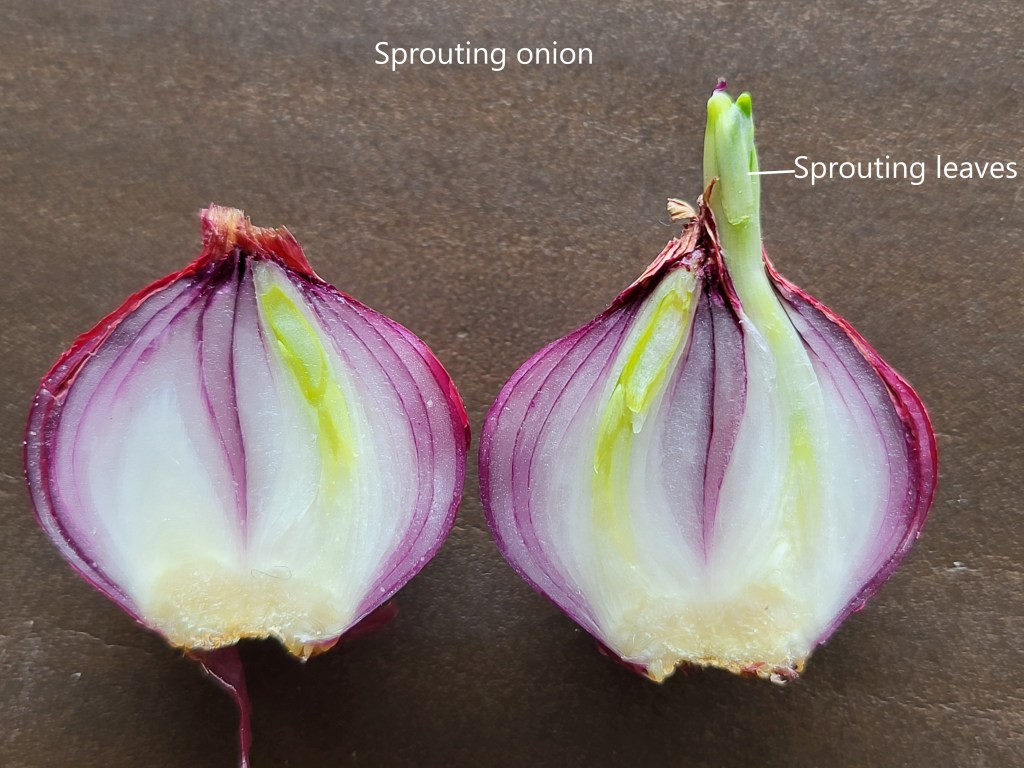
Today, we’re going to explore the transformation of an onion bud into a sprout. To do this, let’s cut open an onion lengthwise. This will give us a clear view of all the different parts, including the roots, stem, fleshy leaves, inner buds, and papery covering.
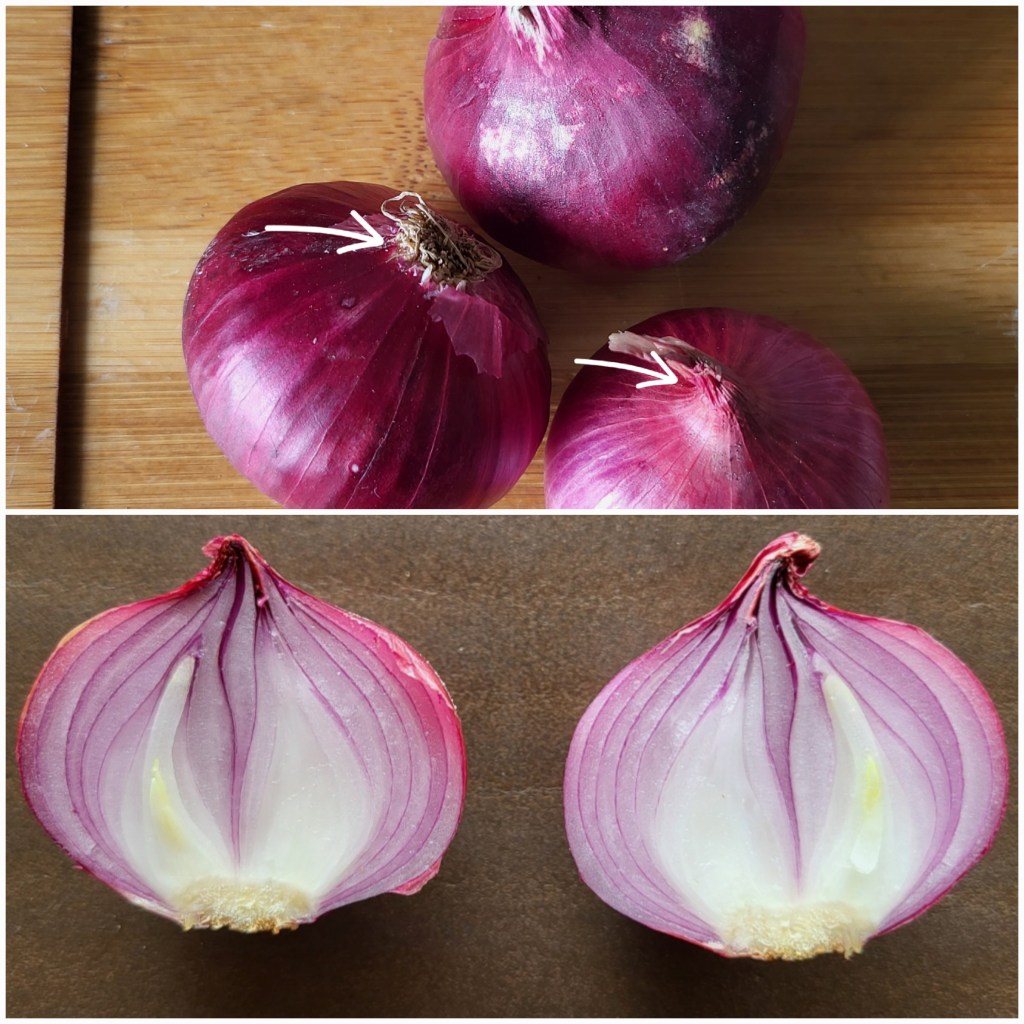
Luckily, we have two onions to compare: one that’s fresh onion and another that’s just starting to sprout.
The top picture shows just a fresh onion. Notice the fleshy leaves and tiny buds nestled at the center.
In contrast, the lower picture shows the onion at the very initial stage of sprouting. Here, you can see the bud has elongated, become slightly transparent, and developed a faintly colored tip. You can also see the lightly yellowish leaves inside the bud.
An enlarged photograph shows the labeled parts of the initial stage of sprout inside an onion
First tubular sheath: A protective layer of fleshy leaf that shields the delicate parts of the new bud.
Green leaves: These will grow upward to produce food for the new plant through photosynthesis.
Tubular white sheaths: the upper part of which develops into the pseudo stem, and lower part becomes the onion bulb which we call the onion.
New stem: The stem that supports the new plant.
As an onion matures, begins to naturally sprout under the right conditions. This marks the start of an exciting new phase, where the onion’s energy shifts from growing a bulb to reproducing.
During sprouting, new bud stems are activated, producing fresh leaves that emerge from the circular base of the mother onion. These leaves are initially white, tubular sheaths with pigmentation on one side. Interestingly, each subsequent leaf has its pigmentation on the opposite side of the circle. Eventually, the pigmented parts become green and develop into green leaves.
As the new stems grow, they work together with the old stem to push the leaves upward toward the sunlight. The green leaves grow rapidly, outpacing the white, tubular parts. Once exposed to sunlight, these green leaves use photosynthesis to produce food for the new plant, marking the beginning of a new life cycle.
In this remarkable process, the mother onion plays a vital role, supporting the growth of its offsprings as they reach for the sun.
In this picture, the sprouting is seen at a more advanced stage. Some leaves have already emerged, while others remain protected inside the first tubular sheath.
Eventually, each sprout grows and become small plants complete with leaves, stems and roots.
As we studied the sprouted onion, we discovered how the green leaves break free from their first tubular sheath. Stay tuned for the next part of our journey!
In our previous post, we observed two sprouts grow into thriving onion plants, revealing the intricate beauty of nature’s design. The onion plant’s simplicity belies its remarkable complexity, with just a few leaves working in harmony to perform all essential functions. Each leaf plays a unique role, whether it’s green and photosynthetic, white and storage-rich, or fibrous and supportive. Together, they form a self-sustaining whole.
The Green Leaves: Food Producers
The green leaves of the onion plant are an extension of the fleshy leaves inside the onion bulb. They produce food for the plant through photosynthesis and send it to the bulb for storage. This process is crucial for the plant’s growth and development.
The Fleshy Onion Leaves: Storage and Protection
The fleshy onion leaves play a dual role: they receive and store nutrients produced by the green leaves and shield the stem and inner buds. They also produce a sulphur compound as a chemical defense mechanism, which can sometimes bring tears to our eyes.
The Pseudo Stem: A Marvel of Engineering
But that’s not all – these versatile leaves also form the intricate, layered pseudo stem, which supports the green leaves and enables them to stand upright. This unique structure maximizes their exposure to sunlight, allowing them to produce even more food for the plant. It’s a remarkable example of functional unity in nature.
The Three Phases of Onion Growth
The onion plant’s life cycle consists of three phases: vegetative, bulbing, and flowering. We’ve already explored how the leaves work harmoniously during the vegetative and bulbing stages to develop the onion plant.
During the flowering stage, the same leaves concentrate their energy on the flower stalk, diverting all their food and nutrition to support the growth of flowers and seeds.
In our next posts, we’ll continue to explore the life cycle of the onion plant, from the initial stage of a new bud to the production of new buds for the next generation. Stay tuned!