
After exploring the vibrant flavours of Southeast Asia, I’m taking a short detour to share a special story with you – the journey of mung beans from flower to harvest, following up on my previous post in the Seed2Seed series. Join me as we dive into the fascinating process of how these tiny legumes grow, mature, and eventually make their way to our plates.
Mung Bean Journey: From Flowers to Harvest
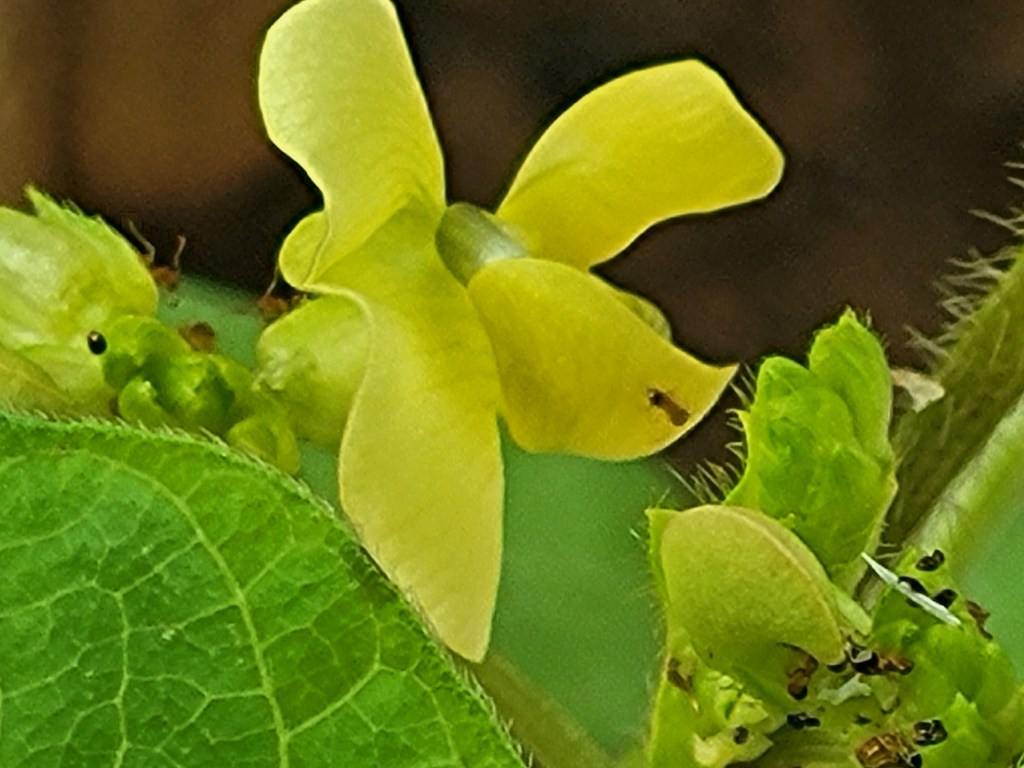
On my balcony, mung bean plants in pots are buzzing with life. As the flowers blossom, tiny ants move from one flower to another, collecting food and transferring pollen. This process helps the plants reproduce, and I’m excited to see the fruits of their labour. These tiny creatures are playing a big role in bringing my mung bean crop to life!
Let’s embark on this mung bean adventure together!
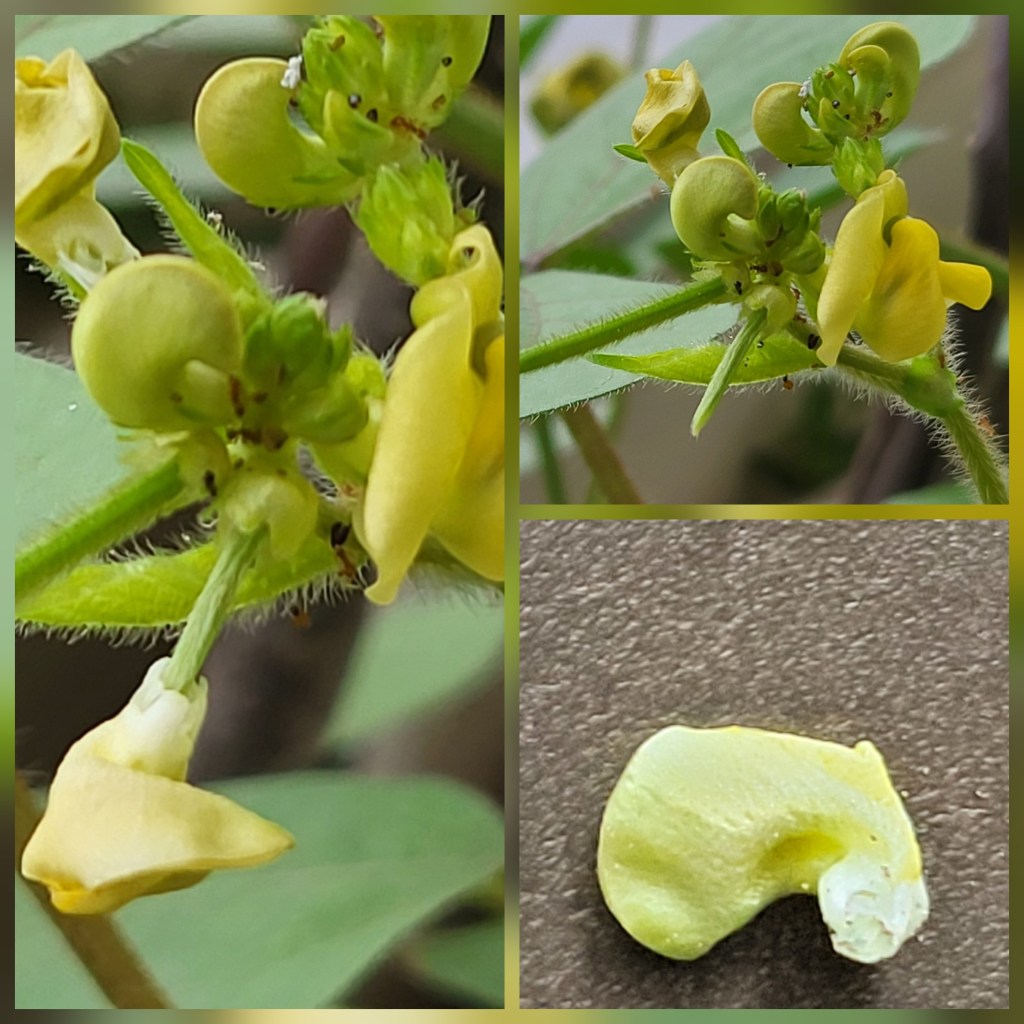
Four days later, as I gazed upon my mung plants, I noticed a tiny mung bean was peeking out from one of the flowers, with a withered bloom still clinging to its tip. I watched in fascination as the dried flower suddenly dropped off the tender pod.
Curiosity got the better of me, and I gently picked up the fallen flower. I decided to dissect it, eager to explore its intricate parts. It was a chance to learn, and I didn’t want to waste a fresh flower.
As I carefully examined the flower’s structure, I felt a sense of wonder at the intricate details of nature. The experience deepened my appreciation for the tiny, often overlooked wonders in my garden.
The lower part which holds the flower was left behind on the plant as the developing pod.
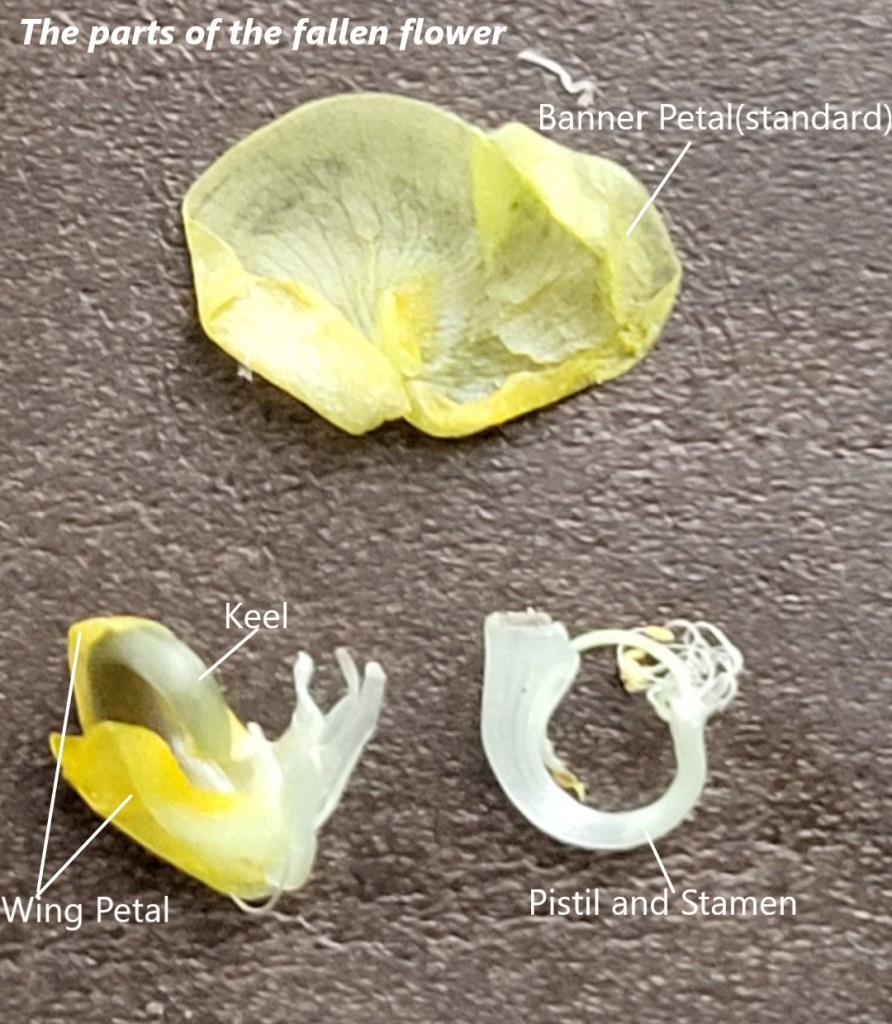
To better understand the flower’s structure, I consulted online resources to identify the different parts, as I am not a botanist. With newfound knowledge, I started labelling them.
Feeling more confident, I decided to dissect a fresh flower, knowing exactly what to look for. Since each flower typically yields only one pod, I was mindful not to waste any flowers in the process.
After the rain, most of the flowers had dropped off, leaving only 3-4 on the plants. Not wanting to wait, I carefully plucked one flower with a sharp blade, eager to observe its structure up close.
Parts of the Mung Flower
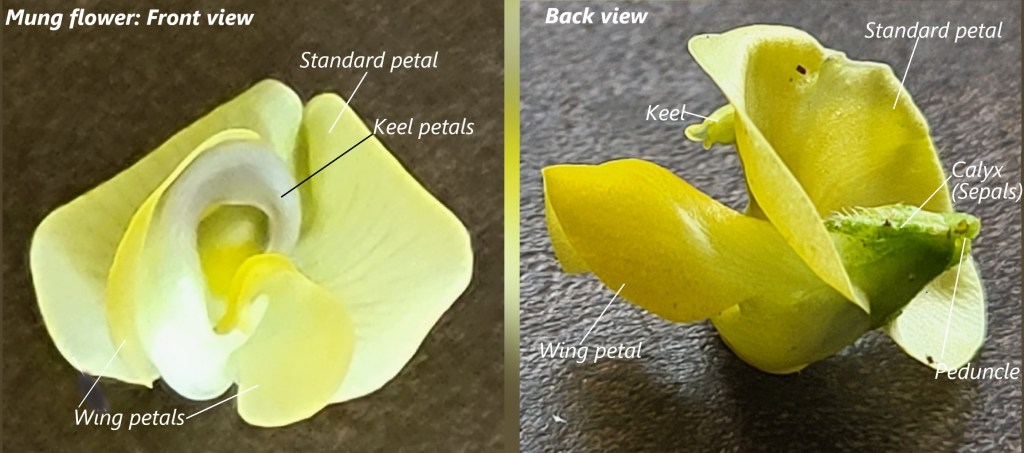
Standard (Banner) Petal: The large, upright, and most prominent yellow petal at the top of the flower.
Wing Petals: The two lateral yellow petals on either side of the keel.
Keel Petals: The two lower petals, often fused, forming a boat-shaped structure that encloses the reproductive organs (stamens and pistil).
Calyx/Sepals: The green, leaf-like structure at the base of the flower, protecting the bud and supporting the petals.
Peduncle: The stalk that supports the flower, connecting it to the stem.
Removing the petals was a delicate task – the flowers were so small (1.2 cm) and tender that it was almost a challenge with my larger fingers. Holding the flower steady was tricky, let alone cutting the petals. Despite the difficulty, I managed to do it with one flower, and I’m thrilled about that.
Dissecting the Flower
The dissection process involves removing the petals in the following order:
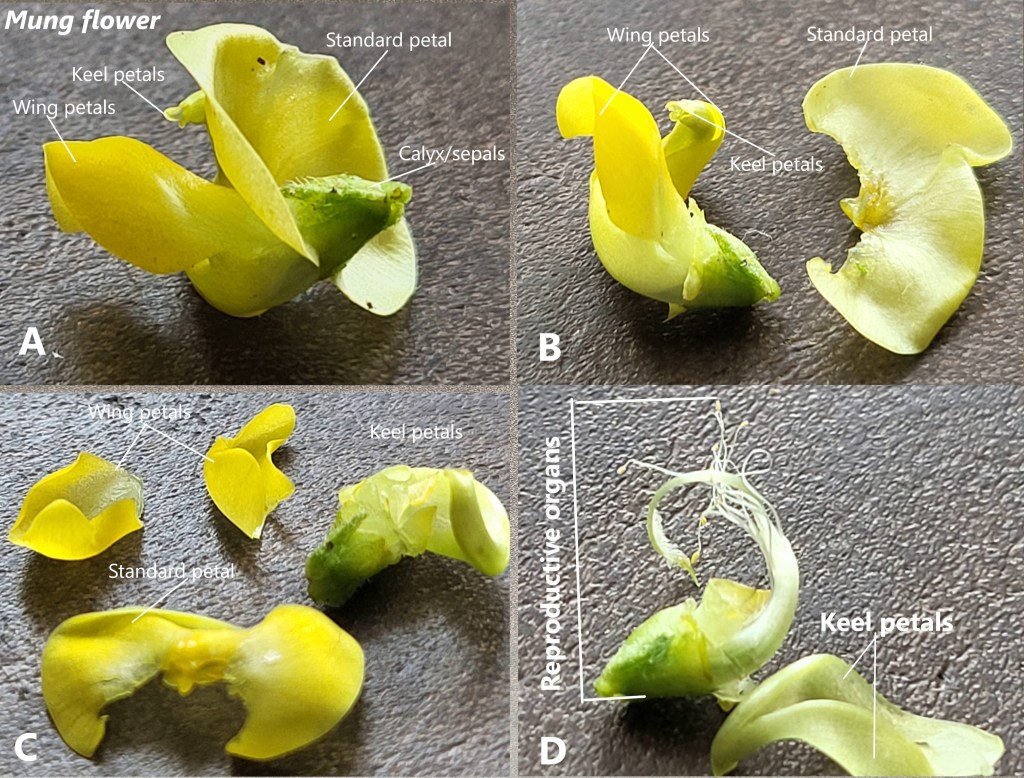
1. Standard petal (B)
2. Wing petals (C) (two in number)
3. Keel petals (D) (two fused petals forming a boat-shaped structure that protects the reproductive organs)
Dissecting the Reproductive Organ
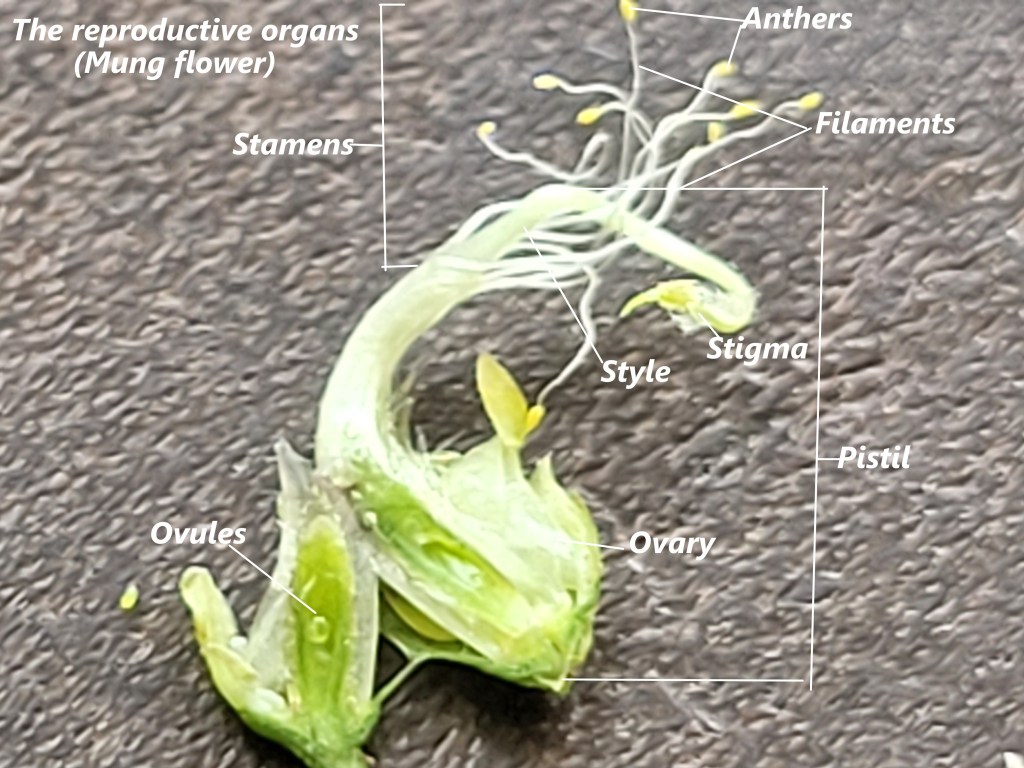
Upon removing the keel petals, several parts of the reproductive organs became visible.
Further dissection of the ovary revealed the green ovules, which will eventually develop into seeds.
Pistil: The Female Reproductive Organ which consists of three main parts:
Stigma: The curved, receptive tip where pollen lands.
Style: The long, slender structure connecting the stigma to the ovary.
Ovary: The swollen base of the pistil, containing ovules that develop into seeds (though not clearly visible here).
Stamens: The Male Reproductive Organ which comprises of:
Anthers: Small, yellowish sacs at the tips of filaments, responsible for producing pollen.
Filaments: Slender stalks supporting the anthers, extending upwards.
Mung plants are self-pollinators. They can transfer pollen from their own mate part anthers to their own female parts stigma resulting in self-fertilization. Such plants are known as autogamy.
The advantage is they don’t need external pollinators like bees and ants.
Happy reading!
Coming up next …… From Petals to Pods
******


very pretty!
LikeLike
Thank you Meeta.
LikeLike
so interestingly written…such in depth study. Keep up the wonderful work.
LikeLike
Thank you so much, Leeta, for your kind words! I’m happy that you enjoyed my revisit to Mung Bean’s Journey. Your encouragement means a lot to me, and I’m grateful for readers like you who appreciate the effort I put into sharing these stories. I’ll definitely keep up the good work!
LikeLike
Very informative and well-presented! I never knew the mung bean’s growth process was so fascinating. Thanks for sharing this wonderful journey.
LikeLike
Thank you so much, Protima, for your kind words! I’m thrilled that you found the mung bean’s growth process fascinating. It truly is amazing to see how something so small can grow into a beautiful plant. I’m glad you enjoyed the journey!
LikeLike
Such sharp insights & elegant writing, truly impressive. Keep it coming!
LikeLike