
Forming the Pseudo Stem:

The onion’s white tubular sheaths emerge from its stem, playing dual roles: forming the pseudostem to support green leaves for photosynthesis and storing excess food in the underground bulb for later use.
Now let us focus on Pseudostem Formation
The pseudostem is built layer by layer as new leaves emerge from the center of the plant. Each leaf consists of a green blade and a white tubular sheath. The green blade/leaves alternate with sequential tubular sheaths.
As new leaves emerge, they grow through the center of the existing sheaths, pushing through the tubular structures and forming a concentric layer.
This process repeats, adding layers to the pseudostem, which provides structural support to the plant, allowing it to grow upright and expose its leaves to sunlight.
The green leaves, at the top, are responsible for filling their corresponding tubular sheath with nutrients during its lifetime.
A Closer Look at the Tubular Sheath and Green Leaf
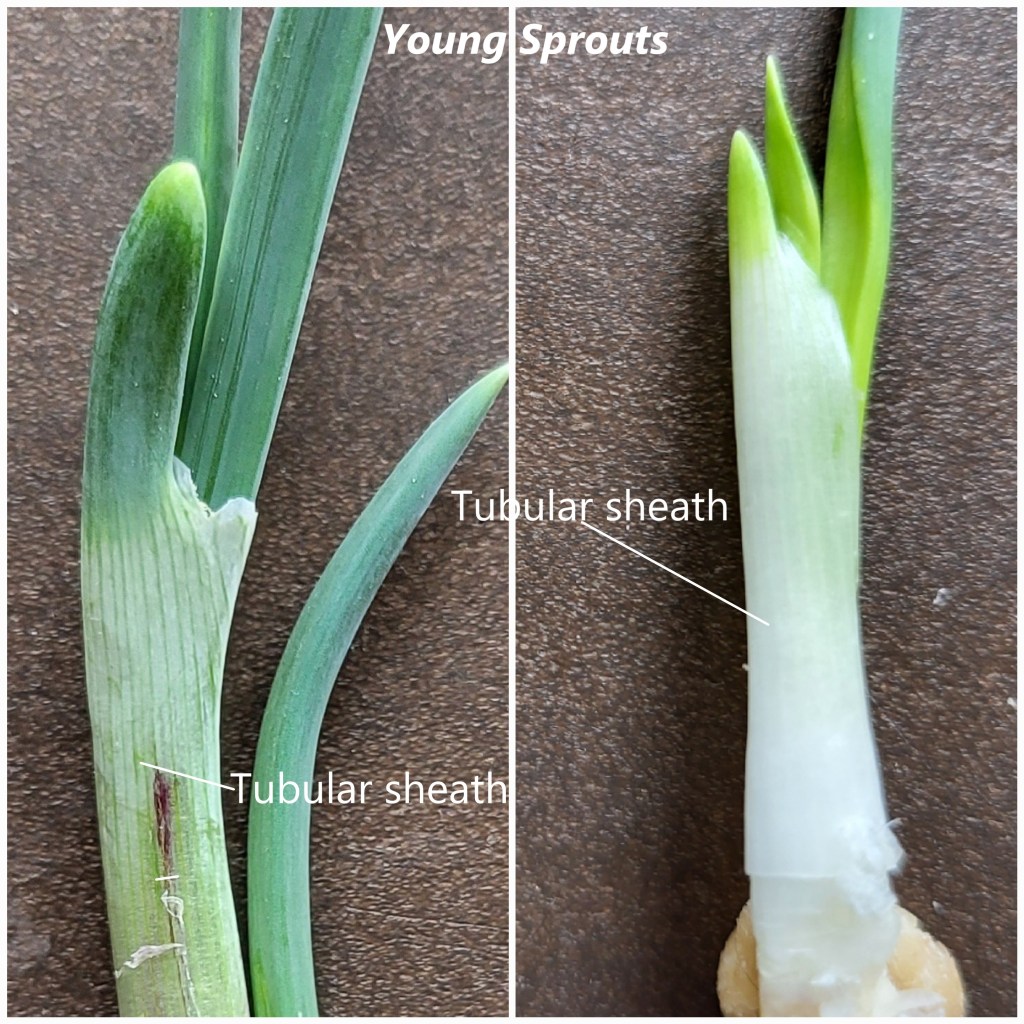
As new green leaves emerge, their tubular sheaths wrap tightly around the inner leaves, offering support and protection. This process is particularly visible in young sprouts, where the overlapping sheaths form a sturdy pseudostem.

In this way, each sheath holds the inner green leaves snugly, with each subsequent sheath growing slightly higher than the last. This layered structure allows the green leaves to emerge progressively higher, exposing them to sufficient light for photosynthesis and thus forming the pseudostem.
Veins of Tubular Sheath and Green Leaf
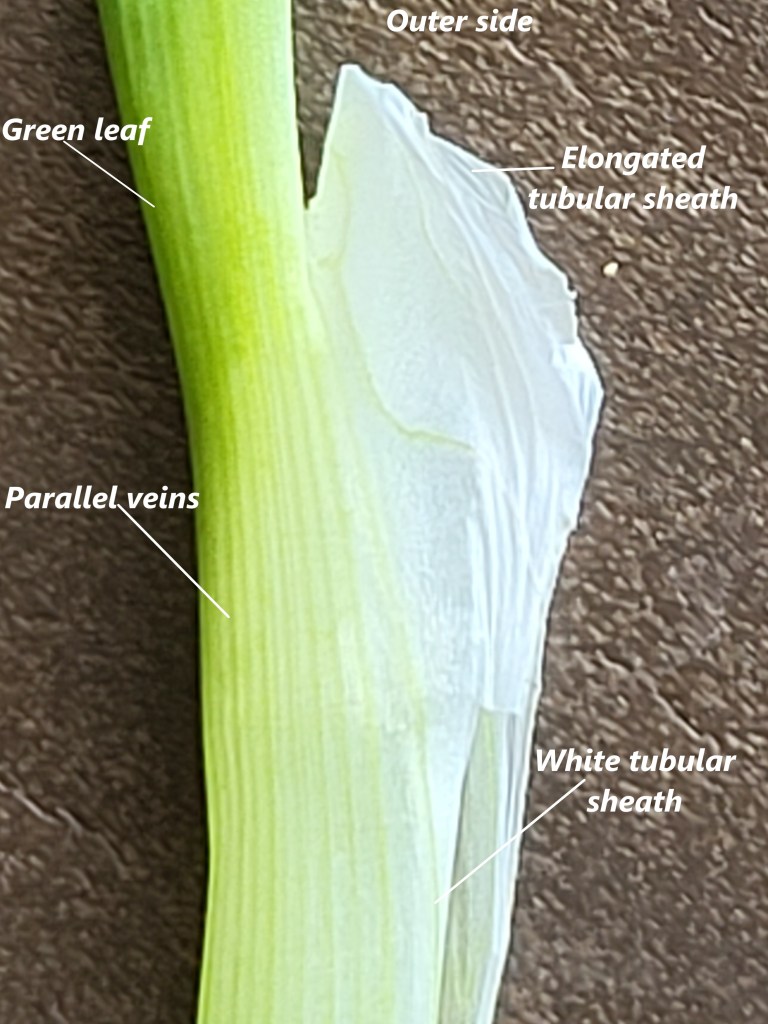
The veins of the tubular sheath seamlessly extend into the green leaf. When viewed from the outer side, the veins run parallel.
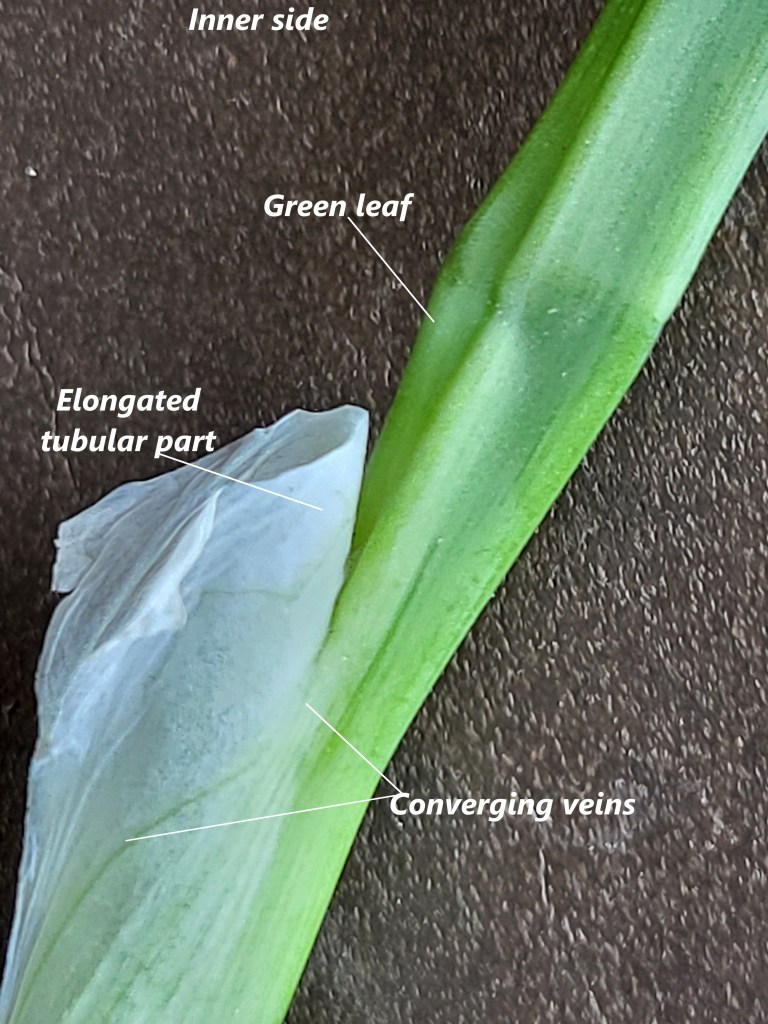
In contrast, the inner side shows a converging pattern, where the veins of the tubular sheath meet the green leaf, forming a flat surface. This arrangement allows for tightly packed green leaves.

The green leaf branches out from this point, while the tubular sheath continues to elongate a little, wrapping tightly around emerging inner leaves.
As each new leaf emerges, its tubular sheath wraps protectively around it, supporting the leaf during growth. This process repeats with each subsequent leaf, which creates elliptical holes or openings in the sheath as it pushes through. The result is the characteristic structure of the pseudostem.
As we previously discussed, the green leaves grow in an alternating pattern from the tubular sheaths, resulting in the distinctive V shape due to the slight extra growths from the sheaths, ultimately forming the wonderful pseudostem.
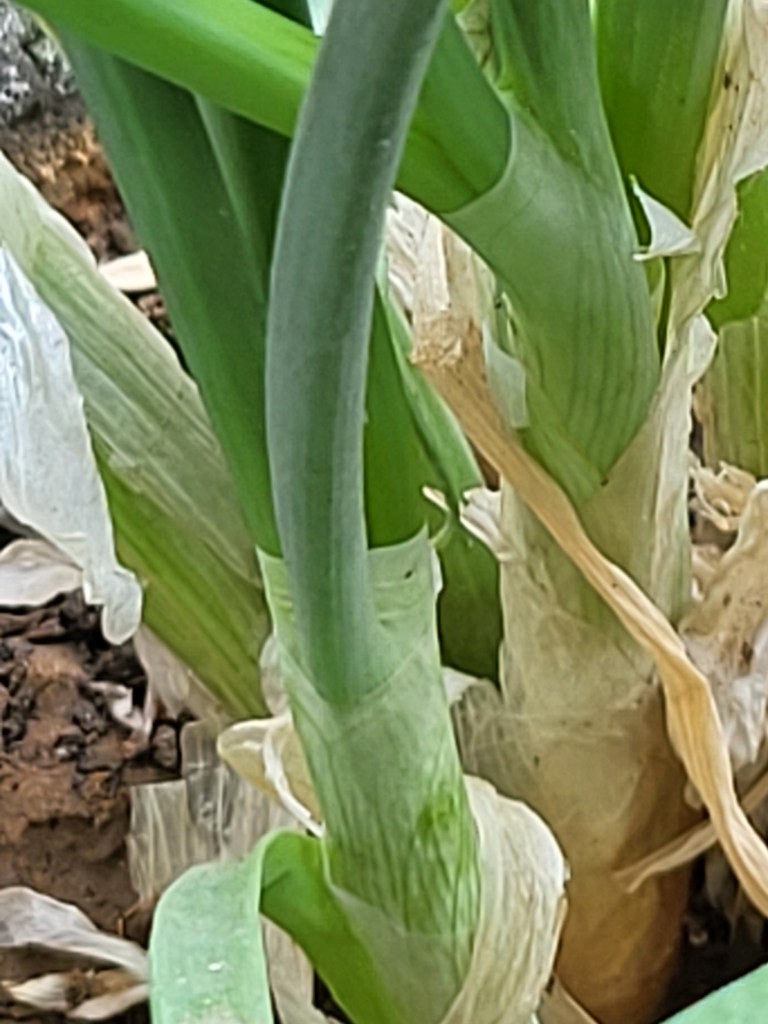
The tubular sheaths possess flexible properties, allowing them to stretch and accommodate the plant’s growth. However, over time, the sheaths become increasingly thin and fragile, eventually succumbing to wear and tear.
Coming up next …… Structure of Green Leaves
*******
 Dal On The Table
Nowhere have I read such a crystal clear description of a complex plant process! Keep it up.
LikeLike
Thank you Anku. You are always so encouraging.
LikeLike
very interesting!
LikeLike
Thank you Lita.
LikeLike
👍
LikeLike
Thank you Meeta.
LikeLike
very iinformative!
LikeLike
Thank you Kumi.
LikeLike