
Sprouting: A New Chapter in an Onion’s Life
Today, we’re going to explore the transformation of an onion bud into a sprout. To do this, let’s cut open an onion lengthwise. This will give us a clear view of all the different parts, including the roots, stem, fleshy leaves, inner buds, and papery covering.

Luckily, we have two onions to compare: one that’s fresh onion and another that’s just starting to sprout.

The top picture shows just a fresh onion. Notice the fleshy leaves and tiny buds nestled at the center.
In contrast, the lower picture shows the onion at the very initial stage of sprouting. Here, you can see the bud has elongated, become slightly transparent, and developed a faintly colored tip. You can also see the lightly yellowish leaves inside the bud.
An enlarged photograph shows the labeled parts of the initial stage of sprout inside an onion

First tubular sheath: A protective layer of fleshy leaf that shields the delicate parts of the new bud.
Green leaves: These will grow upward to produce food for the new plant through photosynthesis.
Tubular white sheaths: the upper part of which develops into the pseudo stem, and lower part becomes the onion bulb which we call the onion.
New stem: The stem that supports the new plant.
As an onion matures, begins to naturally sprout under the right conditions. This marks the start of an exciting new phase, where the onion’s energy shifts from growing a bulb to reproducing.
During sprouting, new bud stems are activated, producing fresh leaves that emerge from the circular base of the mother onion. These leaves are initially white, tubular sheaths with pigmentation on one side. Interestingly, each subsequent leaf has its pigmentation on the opposite side of the circle. Eventually, the pigmented parts become green and develop into green leaves.
As the new stems grow, they work together with the old stem to push the leaves upward toward the sunlight. The green leaves grow rapidly, outpacing the white, tubular parts. Once exposed to sunlight, these green leaves use photosynthesis to produce food for the new plant, marking the beginning of a new life cycle.
In this remarkable process, the mother onion plays a vital role, supporting the growth of its offsprings as they reach for the sun.
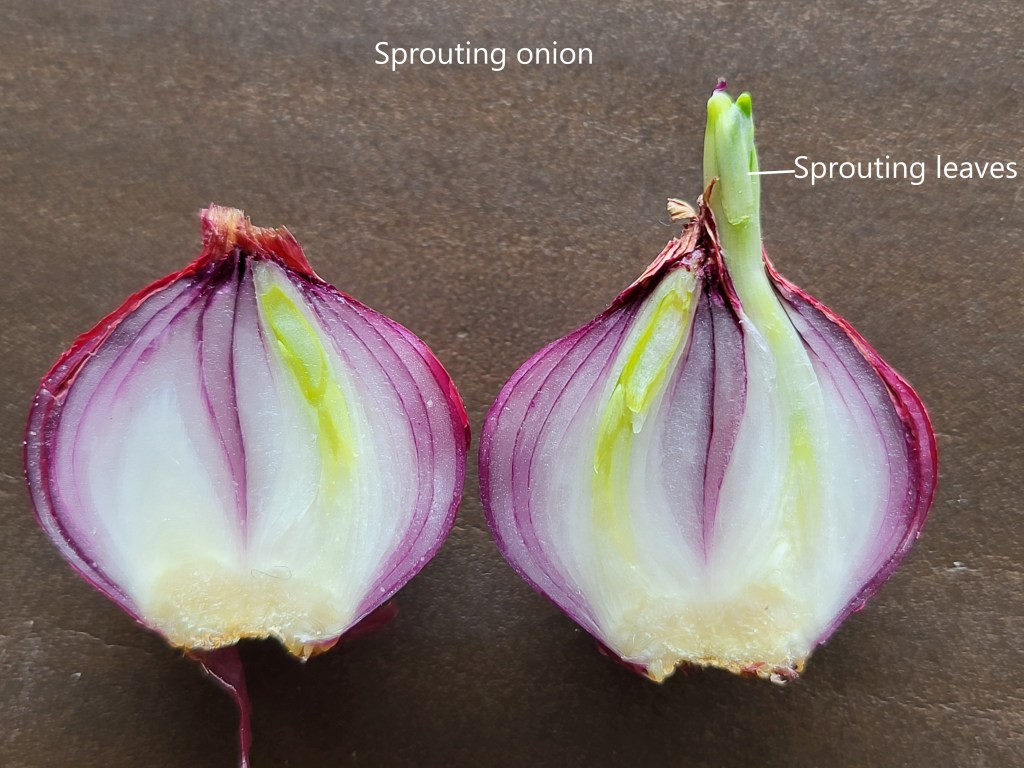
In this picture, the sprouting is seen at a more advanced stage. Some leaves have already emerged, while others remain protected inside the first tubular sheath.

Eventually, each sprout grows and become small plants complete with leaves, stems and roots.
As we studied the sprouted onion, we discovered how the green leaves break free from their first tubular sheath. Stay tuned for the next part of our journey!
Happy reading!
Coming up next ………… Sprouts: The Tiny Powerhouses
*******
 Dal On The Table
You beautifully capture the transformation aai….looking forward to more
LikeLike
Thank you so much Protima for following the post regularly.
LikeLike
VERY informative!
LikeLike
Thank you Kumi.
LikeLike
Interesting !
LikeLike
Thank you Meeta.
LikeLike