
In my previous post, I shared a big mistake: not separating individual sprouts. When we planted the whole onion with sprouts (each sprout was a plant), and each plant had to compete for space inside the onion, hindering their growth.

But how did I realize each sprout was a separate plant?
Let’s explore the onion’s internal structure.

When you hold an onion in your hand, you’ll notice the dry, papery skin covering it. This skin is actually made up of the onion’s first few leaves, which have shriveled and dried over time.
Despite their fragile appearance, these ‘tunic’ or ‘scaly’ leaves serve as a protective barrier, shielding the onion from moisture loss, insects, and germs. When we peel away this outer layer, we’re rewarded with the crunchy, flavorful flesh inside, perfect for cooking.
To take a closer look at the onion’s internal structure, let’s cut it in half lengthwise, or longitudinally. This will give us a clear view of the different parts inside. We can then label each part on the photograph for better understanding.
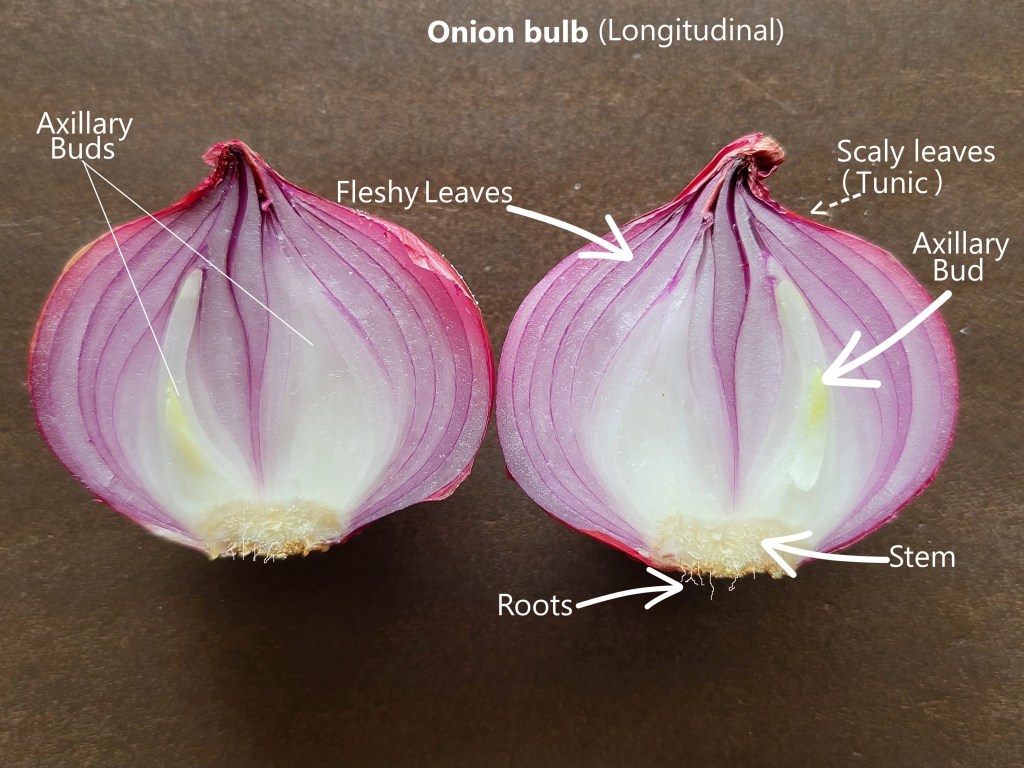
Slicing an onion lengthwise, reveals the various parts of the onion, making it easier to understand its composition.
1. Scaly Leaves (Tunic): The dry, papery skin that protects the onion from drying out and keeps insects and germs away.
2. Fleshy Leaves: The edible part of the onion. These leaves store nutrients produced by the green leaves, protect the central buds, and release chemicals that irritate eyes.
3. Axillary Buds: Future onion plants scattered around the center. These buds have the potential to grow into new onion plants.
4. Terminal Bud: Located at the center, this bud produces the flower stalk, which bears seeds and ensures the onion plant’s cycle. Not visible in the picture.
5. Stem: A condensed, short stem from which leaves and buds grow.
6. Roots: Adventitious roots that absorb minerals and water for the plant.
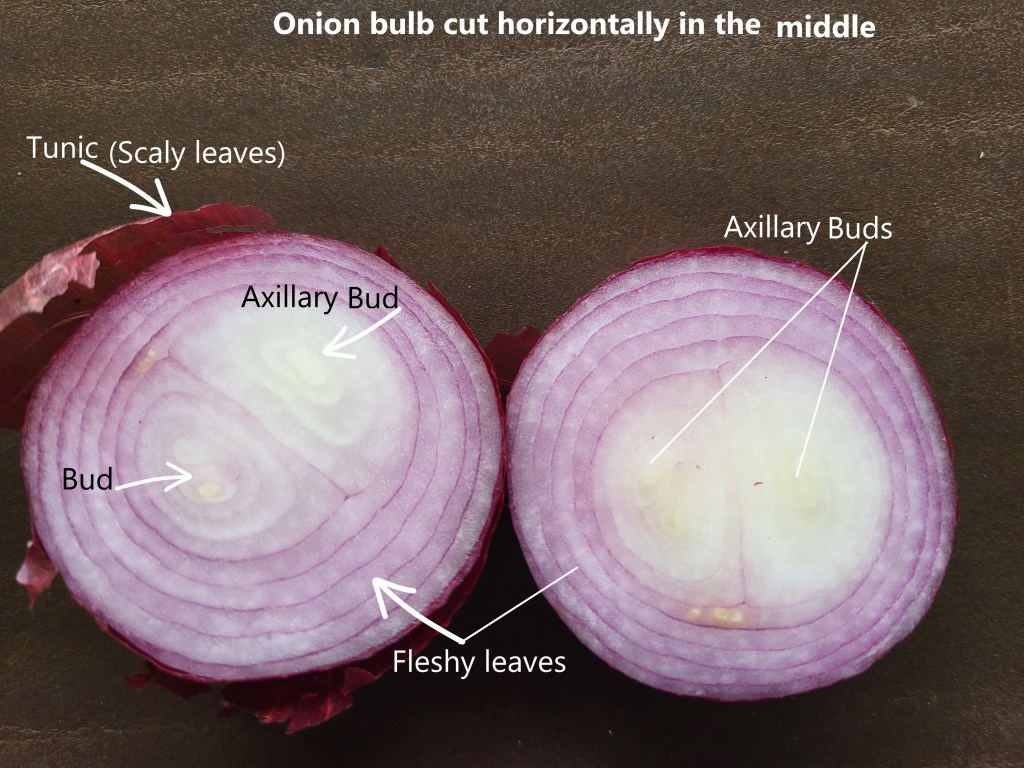
When you cut an onion horizontally, you’ll notice a beautiful pattern of concentric circles. These circles are actually the fleshy leaves that make up the onion bulb.
Take a closer look and you’ll see how these leaves curve inward, eventually joining together at the center of the onion, where the tiny buds are located. These buds are special, containing both terminal and axillary buds.
Onions typically have 2-5 hidden buds, called axillary buds. Amazingly, each of these buds has the potential to grow into a brand-new onion plant!
At the center of the onion, there’s a single terminal bud that plays a crucial role. Although it’s not visible in the picture, this bud grows into the flower stalk, which eventually produces a flower and seeds for new onion plants.
Now that we’ve explored the internal parts of an onion, remember that having a little knowledge about something can spark curiosity. When you encounter it again, you’ll likely to feel more intrigued and want to learn even more.
Our next journey will be to the heart of the onion, by carefully peeling away each layer to reveal the secrets within.
Happy reading!
Coming up next …….. Layer by Layer.
********
 Dal On The Table
What a meticulous research!!! Waiting to see an onion’s heart!♥️
LikeLike
Thank you so much Meeta.
LikeLike
Great post ! I love how you explained the onion’s structure
LikeLike
Thank you Protima.
LikeLike
Thank you Protima.
LikeLike