

Ladakh is a union territory, on the extreme north end of India. It has two capitals – Leh and Kargil. Leh is the summer capital and Kargil the winter capital.
Ladakh shares international boundaries with Tibet in the east and Pakistan in the west.
The Indian states, Himachal Pradesh and Jammu & Kashmir borders the state on the south.
Ladakh, fondly known as India’s “cold desert”, is a realm of breathtaking beauty. The majestic River Indus, from which India derives its name, winds its way through this enchanting land. The scenery in Ladakh is nothing short of spectacular, with its crystal-clear skies, towering mountain passes, and numerous Buddhist monasteries that dot the landscape. The region’s unique blend of natural wonder and cultural significance makes it a truly captivating destination.
In the tale of Ladakh, locals believe that the legendary King Gesar of Ling was born in Kargil. In the 11th century, this iconic ruler governed both Ladakh and Tibet, leaving an indelible mark on the region’s history. Revered for his extraordinary supernatural powers, King Gesar was hailed as a hero and a guardian of his people. Through his conquests, he brought unprecedented peace and prosperity to his subjects, cementing his legacy as a champion of the realm. The enduring legend of Gesar continues to inspire and influence the people of Ladakh, reflecting the region’s rich cultural heritage and profound spiritual traditions.

Ladakh has many exciting festivals, and the Hemis Festival is one of the most colorful and popular ones! It is also known as Hemis Tsechu Festival. It is annually held in July at the iconic Hemis Monastery, one of the largest and most renowned monasteries in Ladakh, this 2-day festival is a spectacular commemoration of the birth of Guru Padmasambhava, the founder of Tibetan Buddhism and believed by some to be the reincarnation of Lord Buddha.
The festival begins with a wonderful procession of monks wearing colorful costumes and masks, their movements synchronized to the rhythm of traditional music and rituals. The dances are performed to ward off evil spirits, invoking the blessings of the divine. This festival offers a rare and wonderful opportunity to immerse oneself in the rich cultural heritage and traditions of Ladakh, making it an unforgettable experience.
Pulse farming in Ladakh
Pulse farming has been an integral part of Ladakhi culture for centuries, with local varieties being cultivated despite the challenging climate, poor soil conditions, and water scarcity. Yet, pulse farming has proven to be a resilient and sustainable option for local farmers, who work tirelessly to make the most of the short cultivation period of just 4-5 months. During this brief window, they not only cultivate pulses but also a variety of root and green vegetables, which are carefully preserved to last through the harsh winter months. The dehydrated peas and beans, categorized as pulses, are a testament to the ingenuity and hard work of the Ladakhi people, who have honed their farming skills over generations to thrive in this unforgiving yet breathtakingly beautiful region.
Food:
The Ladakhi people have developed a distinct culinary identity, deeply rooted in their Tibetan heritage. Their diet is shaped by the principles of Buddhism, which emphasizes compassion for all living beings, as well as the region’s limited animal resources.
Hearty stews and soups, made with powdered barley, wheat, and vegetables, form the basic foundation of their staple diet. Yaks and cows are raised for milk, butter, and cheese. Over time, the region’s unique geography and climate have influenced the evolution of traditional dishes such as Tsampa (roasted barley flour), noodles, dumplings, and Skyu (a rich stew).
Today, we’ll be exploring the flavors of Skyu, a nourishing stew crafted with dried peas (pulses), wheat, and root vegetables, showcasing the resourcefulness and culinary creativity of the Ladakhi people.
Skyu

Skyu is a truly comforting and nourishing delight! This wholesome stew is a meal in itself, offering a gentle warmth that soothes the senses. Remarkably, it’s prepared without any spices, yet its natural flavors blend together in perfect harmony, creating a truly delicious experience. I highly recommend giving it a try. We loved it!
You need:

100 gm dried green peas
1 medium size carrot
1 medium size potato
1 medium size onion
2 green chilies
½ inch piece of ginger
1 tbsp refined/mustard oil
½ cup milk
Salt to taste

For the dumpling
75 gm wheat flour
Salt to taste
Method:

- Soak the peas overnight.

2. Discard the water and lightly wash the peas again.
3. Place the peas in a pressure cooker.
4. Add ½ tsp of salt and ½ cup of water.
5. Close the cooker and place it over heat.
6. After the first whistle, lower the heat to its lowest and cook the peas for 2 minutes.
7. Allow the cooker to cool down by itself. And keep it aside.

For the dumpling:
8. Take the wheat flour (atta) in a bowl and add ¼ tsp of salt and mix well.
9. Add cold water little at a time to make a stiff dough.
10. Cover the dough and leave it for 5 minutes.

11. Knead the dough on a floured surface for a while.
12. Roll it out and cut into strips.

13. Take a strip and pinch out small amount and make small balls as in the picture.
14. Place the ball on your palm and press out with the thumb of your other hand into small curved shapes.
15. Cover them and keep them aside.

16. Peel, wash and chop the carrot, potato, onion and ginger as in the picture.
17. Wash and chop the chili too.
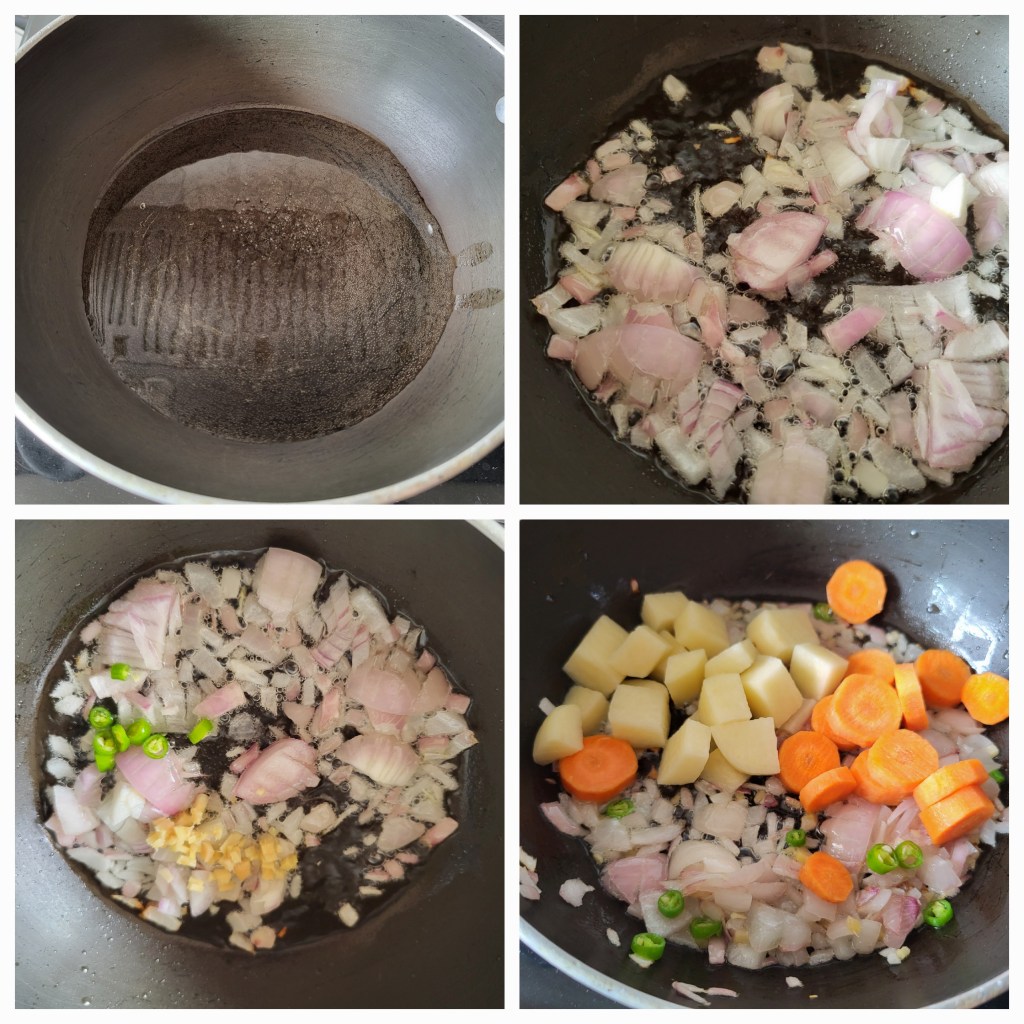
18. Heat oil in a pan. Lower the flame and add the chopped onion and fry for few seconds.
19. Add the chopped garlic and chilies and saute for a while.
20. Add the carrot and potato and saute a little.

21. Increase the flame and add 1 cup of water and bring it to boil.
22. Cook until carrot and potato are soft.
23. Add the cooked green peas and bring it to boil.
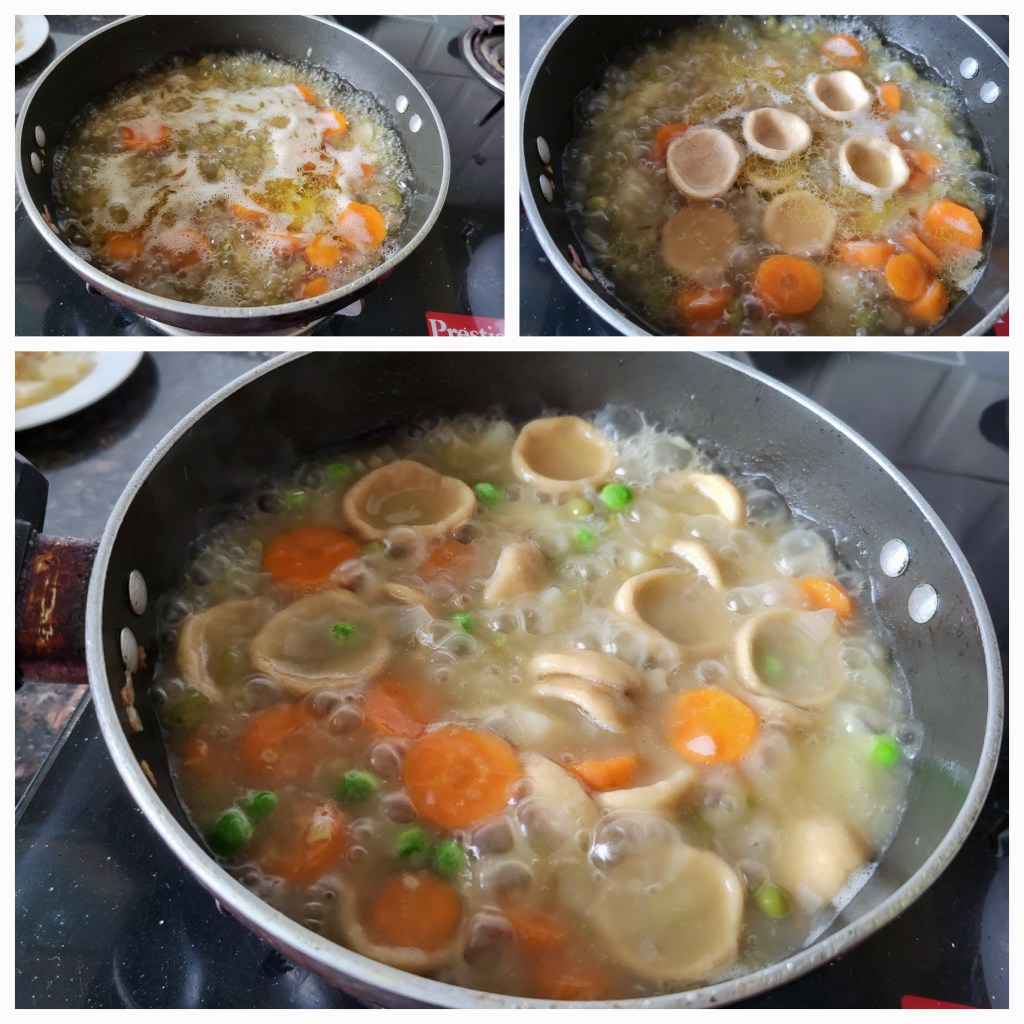
24. Add the prepared dumpling one by one. When the dumpling will get cooked, they will float and come up to the surface.

25. Add ½ cup of milk and adjust the salt.
26. Keep cooking until the gravy becomes little thick.
27.Serve hot.
It is delicious and a full meal by itself.
Happy Cooking!
Coming up next ……………..Dal from Punjab.
******
 Dal On The Table
its a meal by itself…great👍
LikeLike
Thank you Leeta.
LikeLike
All your recipes are amazing 😍
LikeLike
.Thank you Protima
LikeLike
This is something real good to have the wheat within the Recopee ..mydt as my Maid to make it.. seems yummy Indira
LikeLike
Thank you Madhu.
LikeLike